Not Copying, But Recreating: Localization and the Emergence of Chinese Konbini
Haoyu Ma - 2025
Convenience stores have achieved remarkable success in China by localizing the Japanese konbini model to fit the Chinese lifestyle. Japanese konbini brands— 7-Eleven, Lawson, and FamilyMart—entered China in the 2000s, bringing the convenience store concept and their high-quality retail products. However, China’s successful reinterpretation of konbini demonstrates that its prosperity rests not merely as a copy of Japan, but rather as a hybrid that suits the fabric of the modern Chinese lifestyle. Japanese konbini in China not only offer similar convenience store services like instant meals and quick check out, but also make adaptations by localizing the food offerings, store layout, and marketing strategies. These localized approaches have been the key to their success. At the same time, domestic Chinese convenience stores such as Shizu, M.Y.J. (Meiyijia), and Bianlifeng have risen and each developed uniquely to serve China’s huge market and changing lifestyles, characterized by faster pace, higher reliance on technology, and growing demand for convenience and quality. In this essay, to highlight recent trends and consumer attitudes, we will explore different convenience store brands—both Japanese and Chinese—focusing on food offerings, store layout, marketing strategies, and the impact of localization and regional influences. I conclude that in this generation of convenience stores, brands have to move beyond localization and instead differentiate by seamlessly integrating the Japanese Konbini’s core values of convenience, selection, and quality, with the understanding of modern Chinese lifestyles that combines traditional shopping patterns and needs with technology.
Japanese Konbini in China: Interpretation Through Localization
The “big three” Japanese konbini brands–7-Eleven, Lawson, and FamilyMart–have established thousands of stores in China; for instance, Lawson alone has opened about 6,330 stores by the end of 2023. Though each of them faces unique challenges—not the least of which is competition with each other, all have developed their own strategies and gradually localized their operations, even though they might benefit from strategic marketing of their Japanese origins, since Japan as a brands can have positive vibes. Their strategic localization is discernable among the food offerings, store layouts, and marketing strategies.
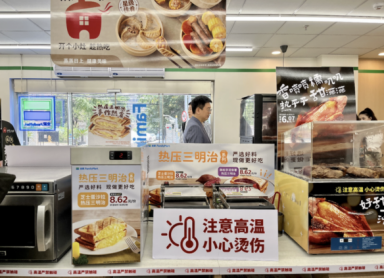
Food Offerings: Japanese konbini interprets and presents J-culture through Japanese foods. From the rice ball, bento, and Japanese sandwiches, to the rack with alcohol such as sake, as well as oden, which people can find in the little hot food bar near the checkout counter, the sheer quantity and variety of Japanese food means that you are bound to find something suiting your taste at that moment. However, the Japanese atmosphere emanates not only from the foods themselves, but also from the packaging: the Japanese words on the label as well as the aesthetics convey a representation of J-culture (fig. 1). All of these appear as an exotic culture that attracts consumers, and because of the high reputation of Japanese products, that identity establishes an image of high-quality instant food, appealing to Chinese customers. On the flip side, new items and localized dishes cater to Chinese palates. Curry fish balls and cart noodles are provided as oden choices at 7-Eleven in Guangdong (fig. 2); in Beijing, FamilyMart developed special spicy crayfish bento boxes and northern Chinese specialties like lamb offal soup; Lawson has similarly introduced pineapple buns and Shunde milk pudding to expand its food selection with local flavors. Moreover, traditional Chinese breakfasts such as steamed buns and tea eggs are sold in the morning, serving as a localized strategy to cope with China’s rich breakfast culture (fig. 3). Continuing to promote their Japanese identity by selling Japanese-style food, konbini in China also meet the needs of Chinese consumers who seek more local flavors, even as they satisfy people’s pursuit of gastronomic curiosity (fig. 7).


Store Layouts: The store layout is yet another focus of the localization strategy. To attract more customers, amenities and layouts have been tweaked to accommodate different shopping behaviors. Traditional konbini in Japan tend to include a diverse presentation of food and services: from various kinds of food like instant food, vegetables, and freshly-baked breads to entertainment such as comic books, as well as daily necessities like ATM, cosmeceuticals, and small digital products. Conversely, konbini in China maintain a smaller scale with limited items in order to fit into people’s everyday lives, adapting to Chinese shopping behavior, in which consumers still prefer to buy vegetables in wet markets and bread in specialty bakeries. Most konbini in China have a floor area of only 50-150 m2, in contrast to Japanese ones that are 40-60 tsubo (130-200 m2), and mainly focus on prepackaged food, beverages, and ready-to-eat items, reflecting the consumption needs of “immediate, small-quantity, emergency.” Konbini in China often aim to provide people a way to get themselves a quick bite—snacks and drinks, rather than depending on them to access to daily necessities, which is more common in Japan. Furthermore, food bars and self-serve kitchens are designed to meet people’s needs for hot food, which is essential in Chinese cuisine. For example, in China, the “fifth generation” of FamilyMart introduced “Hot Food Bar” to let people cook noodles and sandwiches for themselves (fig. 4). This feature marks a shift from Japan, where microwaves are sufficient for reheating food. Many konbini in China have also established parcel pickup counters and mobile phone top-up stations, amplifying their role as a community hub. This balance between small convenience stores and traditional markets and their adaptive layout make the Japanese konbini model fit into the modern Chinese lifestyle and the local community, cementing their success in localization (fig.8).
Marketing Strategy: Konbini in China have learned and drawn marketing strategy from Japanese traditional konbini, and created innovations based on Chinese life patterns. Point of Sales (POS) terminals, a system in which staff apply computerized cash registers to analyze purchasing behaviors, manage stocks, and track consumer data in transactions, have been applied to China’s konbini as a way of marketing strategy and increasing sales. In addition to this mechanism, konbini in China also integrate online and offline sales. The collaboration with Meituan, a Chinese food delivery brand, exemplifies the localized marketing approach of China’s konbini, which combines online and offline inventory management, as well as delivery service. Through this partnership, 7-Eleven is able to get online orders and consumer preferences from the central database for future stock management and selection of store locations. Further, learning from the success of Japanese konbini, memberships and coupons work out as a win-win program among China’s konbini (fig. 5, 6). While offering customers discounts and coupons that are location specific, stores in China also integrate AI and big data to analyze the shopping behavior to make changes to product layouts, such as putting drinks near the checkout desk to encourage people to buy them so they can get a coupon when combining with bento. The implementation of loyalty and function further reflects Chinese innovations—while Japanese konbini rely mainly on in-store cards, konbini in China integrate membership and loyalty function into online platforms such as WeChat and Alipay, allowing consumers to redeem discounts through mobile payments. The marketing strategy taken by konbini in China is dynamic, mixing store-specific promotions, digital engagement, and loyalty incentives to meet Chinese consumers’ needs and shopping behaviors (fig. 9).


“If you bring the business format you used in Japan to China, it won’t work. You have to develop a business format for Chinese lifestyles and tastes,” says Harada, a head of the overseas division at Family Mart’s headquarters in Tokyo, before moving to Shanghai two years ago. This mindset drove brands to make modifications from store layout to selling practices, executing with local flavors, shopping behaviors, and partnerships, while still carrying Japanese DNA that emphasizes convenience, efficiency, and quality. Localization was not a one-time tweak that happened overnight, but a continuous process that draws deeply into the roots of Chinese consumers’ minds.
Rise of Chinese Convenience Store Brands: Shizu, M.Y.J. (Meiyijia), Bianlifeng
In parallel with the expansion of Japanese konbini, China has developed its own convenience store brands in the last two decades. These homegrown companies differ not only from Japanese konbini but also from each other, carrying out unique operation models and marketing methods.
Shizu: Founded in Zhejiang in 2001, Shizu is a regional convenience store powerhouse that mainly operates in eastern China, with its name meaning “ten out of ten” or “fully stocked.” One trait distinguishing it from traditional Japanese konbini is its hours of operation. Rather than operating 24 hours, its running time of 18 hours–from 6:00 a.m. to midnight–fulfills the demand for consumers’ commuter hours while saving on labor and utility costs, suiting many Chinese cities where overnight business is sparse. The growth strategy of 7-Eleven in Japan–open stores together in a certain region to improve visibility and reduce the cost of distribution–won’t largely work in China, where housing prices are soaring, as companies can’t afford high cost of renting, and the 24 hours of operation time would reduce staff enthusiasm, resulting in high cost of night operation. (In fact, even in Japan, the 24-hour model of the konbini is undergoing rethinking due to higher cost of labor.) Shizu has demonstrated that a flexible hours model can be successful if it aligns with local lifestyles in China. While serving nationwide, Shizu is known to heavily feature local and regional snacks, like Hangzhou specialties. Along these lines, in marketing its brand image, Shizu tends to portray and establish itself as a community store–many are franchised and run by local owners–fostering a sense of neighborhood. For instance, its franchised promotion invites people to “join the Shizu family,” and Shizu has been recognized in Zhejiang as a community convenience store, reinforcing the perception as a community neighbor rather than an outlet of a distant corporation. Although its stores do not have the polish of Japanese konbini like FamilyMart or 7-Eleven, they provide quick convenience at slightly lower prices, reflecting the public perception that Chinese convenience stores tend to compete on convenience and price, leaving the high-end market to Japanese brands.
M.Y.J. (Meiyijia): As the largest convenience store chain brand in China, Meiyijia’s strategy is characterized by rapid expansion through franchising in China’s southern and central regions. It is heavily clustered in Guangdong and its adjacent provinces, covering 20 provinces and 220+ cities. The key to its success is its affordability and ubiquity. Though being basic and smaller than Japanese konbini like 7-Eleven, Meiyijia stocks essentials that meet local needs and daily necessities. Meiyijia also built its own POS system in the early 2000s. Combined with its developed self-checkout terminal services, Meiyijia embraces computerization to improve supply efficiency while also effectively reducing consumers’ waiting time, highlighting the deep understanding of “speed first” for convenience stores. However, in the category of fresh food and novelty goods, Meiyijia is not as strong as Japanese konbini brands. It seems aware of this shortcoming and has begun to introduce more ready-to-eat and instant food. For its marketing strategy, Meiyijia tends to use membership deals and store promotions rather than advertising nationwide. Similar to Shizu, Meiyijia’s community-based operation model also wins countless consumers’ trust and support, one that I would articulate as “Chinese convenience store “Chinese convenience store by Chinese for Chinese,” underscoring how well the strategy resonates.
Bianlifeng: Bianlifeng (Convenience Bee) stands out as a representation of China’s new generation of convenience stores, which integrate technology and innovative entrepreneurship into their retail operation model, revolutionizing convenience stores through automation and consumer data. Its core concept is to develop a 24-hour store without a cashier, where customers can scan products and pay via apps with little or minimal human help. In reality, Bianlifeng still has one to two staff coordinating and organizing, but much of its operation is guided by algorithms. Bianlifeng also uses data analysis to match product combinations for each store according to local consumers’ shopping behavior and preferences, which is similar to Lawson’s approach: algorithms will optimize for the top food choices at each store. This highly localized and data-driven marketing strategy is critical under the diverse food landscape in China–best-selling goods in Beijing may not sell as well in Nanjing. However, problems and the feeling of alienation rise up under the highly technical automation model: staff feel like they are “people managed by machines” or “being forced to obey algorithmic decisions.” Chinese consumers also do not universally fully embrace this unmanned concept and still prefer human service at stores. As Mark Gong pointed out, removing human services entirely would not necessarily increase efficiency due to robots’ limits in handling complicated tasks and their high costs of installation and replacement. Bianlifeng is now adjusting to ensure its staff are treated better and to change its robot-driven public image.
Besides Shizu, M.Y.J. (Meiyijia), and Bianlifeng, China also has many other convenience store chains, but most of them are located in gas stations. Regional convenience store chains like Red Flag Chain in Sichuan, Tianfu in Guangdong, Today in Hubei, etc., all achieve a notable position in the convenience store market through understanding of local consumer shopping habits and setting-based needs. In many cities, competition among convenience stores often arises up between Japanese brands and local brands. Chinese consumers nowadays face diverse choices, and all brands try to differentiate: some emphasize 24-hour service, others promote local food, others focus on technological shopping experience and store environment. Notably, while domestic convenience stores do have advantages in scale and reach, Japanese konbini still take the leading position in operation, especially for fresh food offerings, but this gap is diminishing as companies learn fast.
Charts Comparing Japanese Brands with Chinese Brands among Food Offering, Store Layout, and Marketing Strategy
Figure 7. Comparison: Food Offerings Across Japanese and Chinese Convenience Stores
Comparison: Food Offerings Across Japanese and Chinese Convenience Stores | |||
Chain | Japanese Staples | Localized Items | Examples |
7-Eleven | Rice ball, Bento, Sushi, Kushiage, Oden, Sandwiches | Cantonese-style hot snacks in South China, Chinese breakfast | Guangdong: Curry fish balls, cart noodle bowls |
Lawson | Rice ball, Bento, Oden, Fried Chicken, Kushiage | Chinese breakfast, Local dessert items | Beef rice with local flavors e.g. “Angus beef bowl” |
FamilyMart | Rice ball, Bento, Sushi, Kushiage, Bread | Extensive Chinese fresh food line, Hot food | Beijing: Spicy crayfish burger, crayfish rice, mala crayfish onigiri |
Shizu | Rice Ball, Bento | Chinese breakfast, Spicy Chinese Cuisine | Spicy hot pot rice, pickled cabbage and chicken rice |
M.Y.J. (Meiyijia) | N/A | Simple Breakfast | Baozi, Tea egg |
Bianlifeng | Rice Ball, Bento | Spicy Chinese Cuisine | Chuanxiang beef rice |
Figure 8. Comparison: Store Layout Across Japanese and Chinese Convenience Stores
Comparison: Store Layout Across Japanese and Chinese Convenience Stores | |||
Chain | Design & Format | Operating Hours | Examples |
7-Eleven | Compact aisles, some seating | 24h | Downtown hubs, self-checkout kiosks |
Lawson | Clean layout, themed decor | 24h | Ultraman-themed store in Shanghai |
FamilyMart | Modern counters, dining space | 24h | Hot food bar, city center branches |
Shizu | Basic shelves, no seating | 18h (6:00-24:00) | Neighborhood stores in Zhejiang |
M.Y.J. (Meiyijia) | Neighborhood format, some automation | 16h (7:00-23:00) | Human service with Self-Checkout |
Bianlifeng | Minimalist, tech-integrated | 24h | Self-checkout, surveillance camera |
Figure 9. Comparison: Marketing Strategies Across Japanese and Chinese Convenience Stores)
Comparison: Marketing Strategies Across Japanese and Chinese Convenience Stores | |||
Chain | Strategy Highlights | Digital Tools | Examples |
7-Eleven | Seasonal campaigns, premium image | Delivery apps, mobile payments | POS system, Membership, Coupon |
Lawson | Pop culture tie-ins, localization | WeChat loyalty | Membership, Coupon |
FamilyMart | Establish warm image | App rewards, delivery platforms | Membership, Coupon |
Shizu | Community focus, Low price | Minimal online presence | Coupon |
M.Y.J. (Meiyijia) | Local promotions, Membership, Low price | Minimal online presence | POS system |
Bianlifeng | Tech-robot image, Automation | App-based loyalty | Robot Assistant |
Consumer Attitudes and the Impact of Localization
Convenience stores have been embraced by Chinese consumers and seen as an important part of their lives. However, their attitudes towards different brands–Japanese and domestic–are nuanced, with localization playing a significant role in the convenience store market.
Preference for Localized Products: Chinese consumers tend to appreciate convenience stores that meet local flavors and lifestyles. This idea of “food nationalism” exists in many subtle ways—consumers feel more at home when localized snacks or specialties are sold at convenience stores. For instance, the offering of mapo tofu in Chengdu Lawson wins more favor of consumers by showing its understanding of local culture and cuisine. Hence, it is hard for a convenience store to keep its position if it only sells Japanese and foreign products that Chinese customers are unfamiliar with. One reason for the success of Japanese konbini in China, like 7-Eleven, is the understanding of localization: Chinese rich food culture means people expect to get what they normally eat in convenience stores, such as tea eggs and hot noodles. The demand for localized products is increasing, so stores are actively responding, resulting in a hybrid product mix. It is common for people to see a zongzi next to a rice ball in Chinese FamilyMart or an herbal tea alongside Coca-Cola in Lawson. All these kinds of combinations and localization reflect a trend and Chinese consumer taste—a fusion of local and global.
Perceptions of Quality—Japanese vs. Domestic Brands: There is a long-held perception that Chinese consumers are more inclined towards Japanese konbini in terms of product quality and service. Some customers, especially the youth and foreign tourists, prefer 7-Eleven, Lawson, or FamilyMart, even though a domestic convenience store is nearby. However, this gap is narrowing, with Chinese convenience stores like Meiyijia improving their image as a cleaner, fresher, and better-trained store, successfully breaking the stereotype of being inferior. It is also common to see that some people highly praise their experience at Japanese konbini, pointing out that rice balls in Chinese convenience stores feel more like rice with a little filling. However, as a marketing report points out, “64% of Chinese customers are drawn more by the budget-priced, basic products available at convenience stores,” showing that average customers primarily care more about price and convenience. Therefore, people are willing to shop at Chinese convenience stores if they offer slightly lower prices, which is one of the strategies that Meiyijia takes. Moreover, national sentiment and nationalism can also play a role during political tensions or flare‑ups of patriotic feelings—some customers may avoid buying products from Japanese brands. Nevertheless, convenience stores inspire little brand loyalty and their casualization make them a low-commitment choice; most people are pragmatic—they prefer stores nearby or those stores that have what they need or the high-quality products they are seeking.
Consumer Loyalty and Sentiment: Although convenience stores do not have an intense fan loyalty culture like tech or luxury brands, there are preferences among consumers. Some say that “FamilyMart’s fried chicken is the best” or “only trust 7-Eleven’s sandwiches,” while others are more inclined to local Chinese convenience stores as “the auntie there knows me, and it’s cheaper.” According to the 2023 McKinsey China Consumer Report, Chinese consumers have shown a swing to domestic brands in recent years, with a percentage of 49% believing that domestic brands have better quality, partly due to national pride and an improvement of their products. There are nuanced sentiments and various attitudes towards Japanese brands and domestic brands, and this varies depending on region and demography.
Overall, Chinese consumers generally hold a positive attitude towards convenience stores (whether Japanese or Chinese), seeing them as solutions for quick needs under this modern lifestyle. It’s undeniable that localization plays a decisive role in winning people’s hearts: when convenience stores match with the understanding of local cuisine and daily routines, consumers will endorse it through repeated business. Although Japanese brands often carry an aura of being high-quality, domestic brands also gain trust and support through their massive presence and continued improvement. Nowadays, the convergence of expectations towards convenience stores—tidiness, efficiency, localization, etc.—means that all store operations in China are racing towards the same goal from different starting points, and the one getting the best understanding of Chinese consumers and market will stand out.
Conclusion
The convenience store industry in China is vibrant and developing. Localization, though is not the only factor that leads to prosperity, has been proven to be a decisive key to success in convenience store culture. Japanese konbini culture is reinterpreted in China not as an alien import, but as an inspiration that combines with Chinese retail entrepreneurship, fertilizing a new model of the convenience store. Chinese companies build on the culture and model of konbini, making innovations and achieving a technological leap. Meanwhile, Japanese companies continue to improve localization and marketing strategies by learning from Chinese competitors and consumers. Looking forward to the future, I expect further fusion and blend of the both: the innovation of products and tested operation model of Japanese konbini combined with the Chinese retailers’ scale advantage, digital creation, and insight into local lifestyles, creating ubiquitous convenience stores that meticulously meet community needs and achieve minute-level delivery, fulfilling the promise of convenience in a uniquely Chinese way. Every single rice ball that FamilyMart sells or every sale of Lawson’s herbal tea is a little testament: the konbini culture that once belonged to Japan has now become part of Chinese people’s life–reinterpreted and thriving.
Bibliography
Asia Food & Beverages. “Lawson to Increase Store Count to 10,000 in China by the End of 2025.” Asia Food & Beverages. Accessed September 13, 2025. https://asiafoodbeverages.com/lawson-to-increase-store-count-to-10000-in-china/. Industry news article for retail professionals and public, outlining Lawson’s establishment scale and strategic expansion in China, with statistical evidence and no evident bias.
Begin Japanology. “Season 6 EP 29: Convenience Stores Travel Hacks at Konbini in Japan!” NHK World (YouTube video). Posted on [n.d.]. Accessed July 9, 2025. https://www.youtube.com/watch?v=9p8DVJToQEk. Made and produced by NHK World, this episode aims to introduce the functionality, originality, and cultural influence of Japanese convenience stores to a general audience. It combines on-site footage, interviews, with commentary, offering a general overview instead of a deep analysis, useful for functionality and presentation in this study. Since it is produced by NHK, a government broadcaster, it should be noted that there is an overall positive vibe that promotes “Cool Japan.”
Gong, Mark. “Robot-tended Chinese Convenience Chain Bianlifeng Finds Limitations of Automation.” South China Morning Post, August 5, 2024. Accessed August 4, 2025. https://www.scmp.com/business/article/3273122/robot-tended-chinese-convenien ce-chain-bianlifeng-finds-limitations-automation. Written by a journalist for audiences of business readership, this article analyzes the decline of Bianlifeng due to its over-reliance on automation. It provides reporting with corporate data and commentary from industry experts, concluding that excessive automation diminishes adaptability in convenience store operation.
Guangdong Changheng Intelligent Technology Co., Ltd. “新商业时代的便利店发展 与物流建设|便利店物流专题 [Convenience Store Development and Logistics Construction in the New Business Era: Convenience Store Logistics Special].” Guangdong Changheng Intelligent Technology Co., Ltd., March 19, 2019. Accessed August 4, 2025. https://www.gdchim.com/news/472.html. Published by a logistics technology company, this article introduces business practices while explaining supply chain strategies for convenience stores.
ITmedia Business Online. “コンビニの店舗面積はなぜ50~60坪が多い” September 5, 2018. Accessed October 20, 2025. https://www.itmedia.co.jp/business/articles/1809/05/news031.html. This explains why most Konbini stores in Japan occupy 40-60 tsubo (130-200 m2), analyzing store management, sales efficiency, and other business factors. It provides the scale and average land occupation of most Konbini.
Jiemian News. “在便利蜂,人被机器支配 [At Bianlifeng, Humans Are Ruled by Machines].” Sina Finance, March 20, 2023. Accessed August 4, 2025. https://finance.sina.cn/2023-03-20/detail-imymnxfy3459144.d.html. This investigative report on Bianlifeng critiques its algorithm-driven operation. It points out employee stress and dehumanization issues, highlighting that over-reliance on technology can undermine workforce efficiency and sustainability.
Jiemian News. “全家推出新一代门店,想靠‘一日五餐’的细分场景圈粉 [FamilyMart Rolls Out Next-Gen Stores Aiming to Attract Customers with ‘Five Meals a Day’ Concept].” Jiemian News, July 13, 2023. Accessed July 17 2025. https://www.jiemian.com/article/9734443.html A consumer business news article describing FamilyMart’s marketing strategies and store layout. It targets the retail industry, presenting changes as a response to rapid lifestyle and shifting urban consumption patterns.
Jinzhu, Zhou, Yuxiang Wang, and Xunru Wu. “Research on Supply Chain Management Problems and the Solutions Existing in 7-11 Convenience Stores Based on the Intelligent Algorithm.” In Proceedings of the 2021 International Conference on E-Commerce and E-Management (ICECEM 2021), 24–28. IEEE, 2021. DOI:10.1109/ICECEM54757.2021.00013. A peer-reviewed paper addressing the optimization of the supply chain for 7-Eleven using algorithms. Written for academic readers or professionals, it points out the strategic difference between convenience stores in Japan and China, depending on the social context.
Knowledge@Wharton. “Does ‘Made in …’ Matter to Chinese Consumers?” Knowledge@Wharton, 2013. Accessed September 13, 2025. https://knowledge.wharton.upenn.edu/article/does-made-in-matter-to-chinese-con sumers/. Academic-business analysis of Chinese consumer attitudes toward product origin labels. Written for a professional and academic audience, it draws on survey data to conclude that “Made in” still strongly influences purchasing.
Knowledge@Wharton. “Shanghai’s Convenience Store Competition Heats Up.” Knowledge@Wharton, March 27, 1999. Accessed July 18, 2025. https://knowledge.wharton.upenn.edu/article/shanghais-convenience-store-compe tition-heats-up/. An analysis, through a business school platform, outlining the market and competition strategies for convenience stores in Shanghai. Intended for professionals and business students, it offers historical records and benchmarks for current dynamics of the convenience store market.
Knowledge@Wharton. “Thanks, But No Thanks to Made in China?” Knowledge@Wharton, 2011. Accessed September 13, 2025. https://knowledge.wharton.upenn.edu/article/thanks-but-no-thanks-to-made-in-ch ina/. Discusses consumer skepticism toward Chinese-made goods. Aimed at global business readers and retailers, it contextualizes consumer sentiment in globalization and brand trust issues.
McKinsey & Company. 2023 McKinsey China Consumer Report: A Time of Resilience. By Daniel Zipser, Daniel Hui, Jia Zhou, and Cherie Zhang. Greater China Consumer & Retail Practice, December 2022. Accessed August 6, 2025. https://www.mckinsey.com/cn/our-insights/2023-mckinsey-china-consumer-repo rt-a-time-of-resilience. A market investigation report targeting business decision makers, providing data-driven insights into consumer trends in China. It combines survey data with expert analysis to forecast marketing opportunities.
Meiyijia Franchise Platform. “Shizu Convenience Store Brand Page.” mxj.com.cn. Accessed September 13, 2025. https://m.mxj.com.cn/brands/89308.html. Corporate promotional material intended for potential franchisees. It emphasizes Shizu’s brand image and market positioning–Join Shizu Family.
Mintel. “Top Demands of Convenience Store Shoppers in China.” Mintel press centre, July 10, 2017. Accessed August 6, 2025. https://www.mintel.com/press-centre/top-demands-of-convenience-store-shopper s-in-china/. A consumer survey intended for retail convenience store marketers, presenting priorities of Chinese convenience store customers. This report highlights proximity and quality as the dominant purchasing factors.
Shizu Convenience Store. “About Us.” Shizu Official Website. Accessed September 13, 2025. https://www.cnshizu.com/index.html.
Official company profile and website introducing Shizu’s mission and development history. Audience is the general public and potential partners; scope is broad, with a promotional viewpoint.
Telpo. “Why Self-service Becomes the Success Recipe of Meiyijia Convenience Stores.” Telpo blog. Accessed August 4, 2025. https://www.telpo.com.cn/blog/why-self-service-becomes-success-recipe-meiyiji a-convenience-stores. A corporate blog highlights self-service kiosks as a key to Meiyijia’s success. It offers concrete examples of how automation and digital payment enhance retail efficiency.
Toutiao. “不是每个711都有鱼蛋车仔面,它只慰藉广州的凌晨一点 [Not Every 7-Eleven Has Fish Ball Cart Noodles; They Comfort Only Guangzhou at 1 a.m.].” Toutiao, December 27, 2018. Accessed September 13, 2025. https://kknews.cc/zh-my/food/oanop2m.html.
Popular media article highlighting localized food–Curry Fish Balls and Cart Noodles in Guangzhou’s 7-Eleven stores. Written for a general readership, it provides anecdotal, culturally specific insight into food localization and its impact on Chinese consumers.
Vogue Business. “How Asian Consumers Perceive the Value of Brands.” Vogue Business, 2024. Accessed September 13, 2025. https://www.voguebusiness.com/companies/how-asian-consumers-perceive-the-v alue-of-brands.
Market analysis aimed at brand managers and business professionals, examining Asian consumer perceptions of brand value. It situates attitudes within cultural and economic contexts, offering insights for marketing strategy.
Whitelaw, Gavin. “Shelf Lives: Expiration, Extension, and the Cultural Logic of Convenience.” In Consuming Japan: Popular Culture and the Globalizing of Japan, edited by Andrew C. McKevitt, 127–146. Honolulu: University of Hawai‘i Press, 2017. An academic fieldwork drawing on ethnographic research to explore the operation model of konbini. Written for scholars, it links retail marketing to cultural values.
Xiao, Philip. “7-Eleven in China: How Should Chinese’ Choice of Convenience Store Respond to Digitalization?” MBA student submission, Technology and Operations Management, Harvard Business School Digital Initiative. Posted November 14, 2017. Accessed July 17, 2025. https://d3.harvard.edu/platform-rctom/submission/7-eleven-in-china-how-should- chinese-choice-of-convenience-store-respond-to-digitalization/. A case study analyzed by a business school student, examining 7-Elven’s adaptation strategies towards the digitalized retail trend. This analysis applies academic frameworks to a practical marketing situation.
Yilantop. “日本便利店巨头退市,它在中国还好吗? [Japanese Convenience Store Giant Delists — Is It Still Okay in China?].” Yilantop (via Lianshang.com), July 25, 2024. Accessed August 4, 2025. https://www.yilantop.com/article/23730. A news article discussing Lawson’s Tokyo Stock Exchange delisting and its ongoing operations in China. Aimed at business readership, it explains the event within broader trends in the convenience store market.