Fried Food in Japan vs. Fried Food in America
Ronnie Rauch - March 2026
Introduction
There has long been a western fascination with Japan as a nation of people who are healthy, skinny, and long lived. Take, for instance, the Times Magazine article titled “The Land that Doesn’t Need Ozempic”, in which Johann Ari, an American journalist, travels to Japan to supposedly find the secret behind their low obesity rates. The author encounters elementary school students who profess their affection for broccoli and rice, and an “almost mythical” village containing the oldest people in the world. After just a few days of eating Japanese food, the author reports somehow feeling “healthier and lighter.” The Japanese diet has been analyzed by researchers to understand why Japan is so healthy, and the government of Japan advertises the healthiness of traditional Japanese cuisine (Washoku) to increase tourism and soft power.
Yet, many of these depictions of a healthy Japan neglect to mention the popularity of fried food in Japan. Several surveys have reported that over 60% of Japanese people report eating fried food at least once a week. Furthermore, fried foods such as tempura, tonkatsu (fried pork), and karaage (fried chicken) are all considered parts of the typical Japanese diet, even if some are relatively modern additions. Tempura, for instance, was invented in the 16th century. Tonkatsu dates later to the Meiji period, when Western cooking and meat become larger parts of the Japanese diet. To this day, these Japanese foods remain the most popular fried foods in Japan.
Meanwhile, surveys have found that roughly 50% of Americans report eating fast food—typically including some fried food such as french fries—once a week. Despite a similar frequency of consuming fried foods, cardiovascular disease and obesity are much lower in Japan than in the United States. Why does the frequent consumption of fried food in Japan not result in obesity and other issues found in the West and other parts of the world?
Researchers have revealed how other aspects of the Japanese diet—low consumption of red meat, sugar-sweetened beverages, and other processed foods and high consumption of fish and plants—mitigate the impact of fried food. However, I would argue that part of the answer lies in the fried food itself, which I attempted to elucidate in my own project where I compare Japanese fried food to American fried food. While Japanese fried food is still unhealthy, I found that the harmful effects are partially diminished by portion size, the sides consumed alongside the fried food, the thinner breading, and the general use of healthier cooking oils that are exchanged more often.
Cooking Karaage:
In order to obtain a better understanding of what Japanese fried food was like, I sought to myself cook karaage (fried chicken). In various surveys, karaage tends to top the popularity lists. Furthermore, it can be found in more casual environments, ranging from izakaya to konbini. Since fried chicken is a very popular fried food in America, I also thought that through cooking Japanese fried chicken, I would potentially gain an understanding of any potential differences in fried food in Japan and in the United States.
In order to find Japanese recipes for karaage, I searched “からあげレシピ” (“karaage recipe,” translated into Japanese by DeepL). I then looked at various recipes to gain a better understanding of what the general expectations were for a Karaage recipe. It is important to note that every recipe has its own differences when it comes to how much a certain ingredient should be used, and some recipes had more ingredients than others. I soon realized that there was not a single “true” way to precisely cook karaage (or almost all dishes). On a larger scale, this diversity made me confront the fact that assessing an entire culture’s approach to a certain kind of cooking based off of a single meal is a seriously flawed task. In order to have a better understanding of fried food in Japan, I would have to conduct more research.
I was faced with the question of how to cook a version of karaage that I believe would be representative of this dish. Upon examining the recipes closer, I noted an overall trend that would give me a sort of answer to this dilemma. From what I observed, the core ingredients of karaage are as follows: potato starch, cake flour, 250–350 g of chicken, soy sauce, cooking sake, garlic, ginger, and lemon. I decided to define the “core ingredients” as the ingredients that appeared in at least 5 of the 7 recipes that I have researched. The exception to this criterion is cake flour, but I have decided to include it regardless, because it is included in 4 of the 7 recipes and 2 of the 3 recipes that do not include flour acknowledge that it can be used. Lemons were also included in several recipes but seemed to mainly be served alongside the karaage at the end to squeeze on so I didn’t include them as a core ingredient. All of the recipes were rather similar in terms of steps, with the exception of 2 recipes which recommended frying the chicken a second time for an additional minute. While this survey isn’t thorough enough to be properly scientific, I believe that it provided a reasonable guideline to pick a recipe that wasn’t too idiosyncratic.
I decided to follow this recipe because it contained just the core ingredients and had over a thousand positive reviews, implying that it reasonably fulfilled the general expectations for this dish. The ingredients were: 300g of thigh meat, 3 tablespoons of potato starch, 3 tablespoons of flour, appropriate amount of frying oil, 1 tablespoon of soy sauce, 1 tablespoon of sake, ½ teaspoon of grated ginger, ½ teaspoon of grated garlic, and served with a lemon.
Buying the ingredients made me realize how specific ingredients can be. While I did have all-purpose flour at home, I did not have cake flour. Cake flour is thinner than all-purpose flour, which dissuaded me from using all-purpose flour as a substitute. I will concede that perhaps I did bend the truth a bit earlier: 4 out of the seven recipes I examined included flour, not cake flour. However, I decided to include cake flour for several reasons. Two of the recipes still specified the use for cake flour, while the other two recipes did not specify the use of any specific kind of flour. Potato starch is known to give Karaage a light and crispy crust; cake flour is also used in several tempura recipes to make the light crust. Therefore, I thought using a finer flour like cake flour would be more representative of karaage overall.
When it came to buying potato starch and cake flour, I quickly realized that in American grocery stores, all-purpose flour seems to be much more popular. While all- purpose flour was available at my most local grocery store, I had to travel a bit in order to find a store that contained them. And within that store (HEB), all-purpose flour was more plentiful and easier to find than what I needed. This indicates that there is a difference in what kinds of flour / starches are used in America in comparison to Japan.
Cooking sake was not available in any nearby store, so I had to drive 30 minutes to find it. I contemplated potentially substituting it, but since the karaage was meant to be marinated in a sauce containing the sake, I thought cooking sake was an irreplaceable component for the meal.
One slight variation I did make was that I bought minced ginger and garlic instead of grated ginger and garlic. Minced refers to something being cut into very small pieces, while grated refers to something being cut into such small pieces that it turns into a pulp. Grated ginger and garlic are supposed to give off a more intense flavor. I decided that this difference was not too significant, and the minced ginger I bought was actually a paste anyways. Admittedly, I was also a bit nervous about injuring myself using the grater, which is also why I bought the minced versions from the store.
Buying all of these ingredients was quite the ordeal. I spent nearly two hours shopping for all the ingredients! But it made me understand that cooking was as much about the ingredients you use as it was the actual cooking itself. Indeed, I exercised such care because I intuitively knew that the answer to why Japanese fried food doesn’t cause obesity as American fried food lies in part in the differences in the ingredients we use.

Finally, it was time to begin making karaage. The first step was to cut the chicken. I brought out the chicken I had bought from the store, which weighed 1.79 pounds. When I translated that into grams to figure out how much I needed to cut, I was shocked. 1.79 pounds is 811 grams, I only needed to cut out like 3/8ths of the sheet of chicken to get enough chicken for the karaage. It felt like way too little chicken! In my defense, the recipe said that 300 grams was equivalent to a sheet of chicken. Also, the recipes consistently mentioned that it would be enough chicken for two people. Since people like myself who never lived outside the US have any real mental reference for what 300 grams might actually look like, I mentally overestimated how much chicken I would be needing to use by a large margin. To me, the chicken required by the karaage recipes was barely enough for one person! How could two people eat this little chicken? Part of me was convinced that the author of the recipe was lying about how much fried chicken they consider normal to eat in order to look better to their audience. This made me realize that portion size very much also plays a role in the impact of fried food in Japan, and why it is so different than in America.
I then decided to get ahead of the curve and get the cooking oil ready. Thanks to a conversation from Dr. Watanabe, I was aware of the importance of cooking oil when it came to frying. While cooking oil will be discussed more in depth in a later section, I did end up using canola oil, which is very widely used within Japan. The recipe I was referencing recommended to fill 2cm of the pot with cooking oil. I was surprised how much oil this was. Using the remainder of my half-full canola oil bottle was not enough, so I had to run to the store quickly to get a refill.
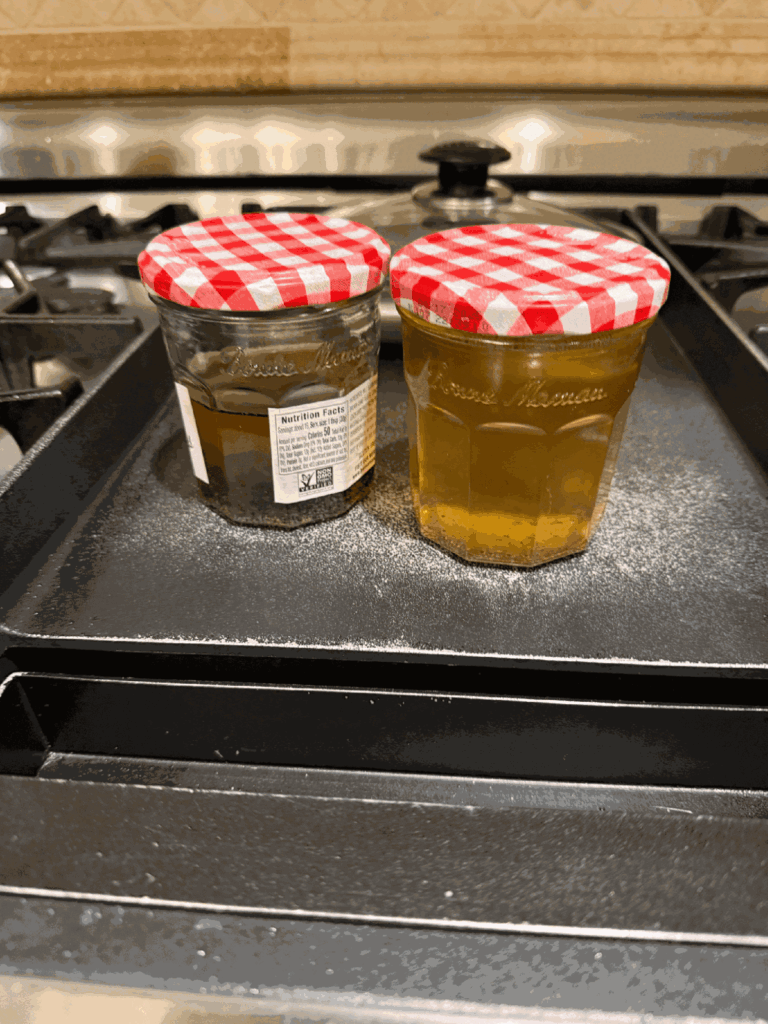
When cleaning up, I realized that there was enough cooking oil in the pot to fill up one and a half jam jars. While this certainly isn’t a scientific measurement, it is a neat visual indicator of how much oil I actually used. While I was aware that using a lot of fried oil does not mean I consumed all of that fried oil, upon looking at the jars I could not help but feel like anything cooked in that much oil must be unhealthy. I still do not want to think about how much oil is needed to cook larger amounts of fried food. To me, it serves as a visual reminder of the importance of cooking oil when it comes to fried food.
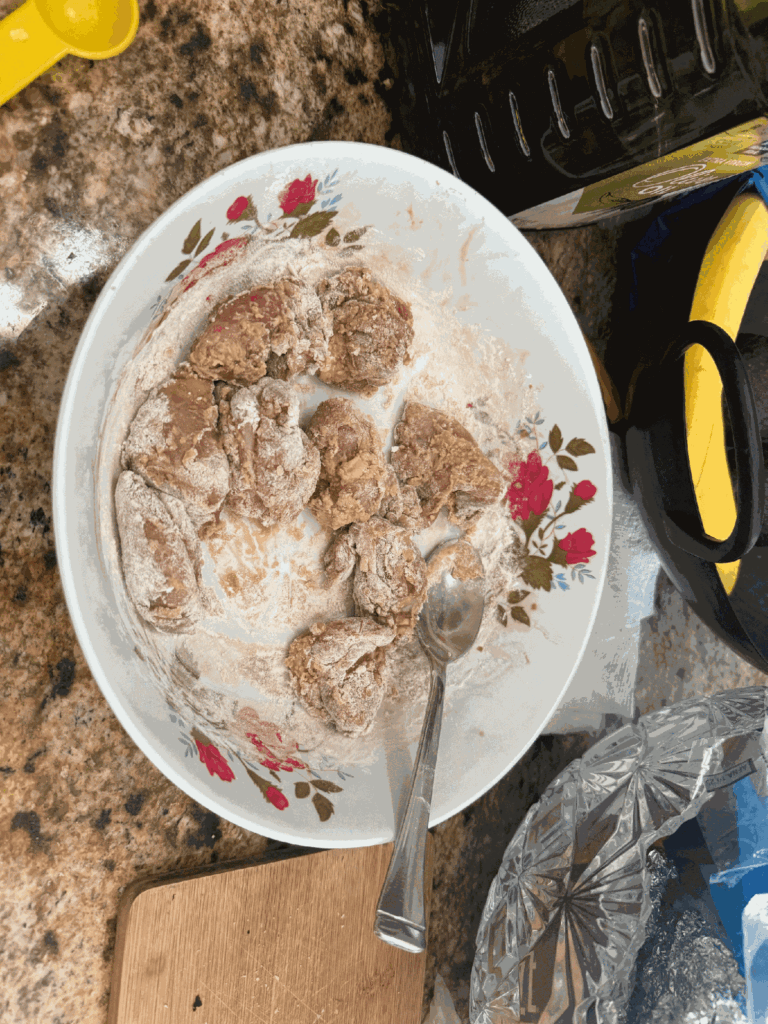
When the 30 minutes were up, I pulled the chicken out of the refrigerator, and added the potato starch and cake flour to the chicken. All the recipes cautioned me to put the starch and flour on evenly, which I followed. Again, I was struck by how little powder there was on the chicken. I was worried that some of the karaage would not have any breading at all and would come out weird. While I haven’t made fried chicken following an American recipe, it is notably thinner than what I have seen on cooking videos on youtube. This was another indicator that karaage had much thinner breading than its American counterpart.
It is at this point that I made a mistake when it came to cooking my karaage. I had no way to measure the temperature of the cooking oil, and falsely assumed that when it hit 170 C, the temperature I was supposed to cook it at, the oil would start bubbling. What I forgot is that bubbling occurs at the boiling point of the substance, which is around 300 C for cooking oil. Luckily, I grew suspicious of the long wait and the strong oily smell, and soon realized my mistake and put in the chicken before it reached that point. However, the oil temperature was notably above the point it was supposed to be, as the chicken turned dark brown almost immediately. I still decided to stick to the recipe and fry the chicken for four minutes.
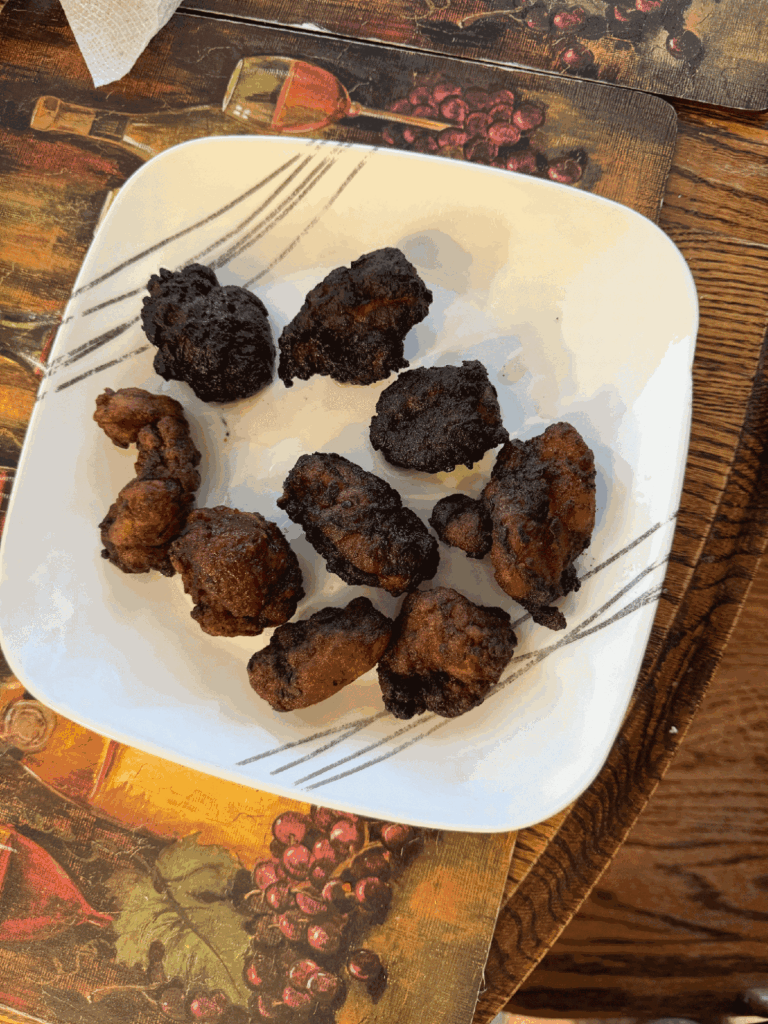
When I pulled the chicken out, a lot of the chicken was clearly much darker than intended. However, it did not burn on the inside at all, and ended up tasting very good. While the breading was burnt, the breading did cover the entire chicken, and tasted notably thin and crispy. It was my first time really cooking anything serious, so I felt really proud of myself that I was able to cook something that tasted good. While the menu recommended it for 2 people, there were roughly 9 pieces of karaage available. When eating it myself, I was under the impression that eating it and some carbohydrate side would probably consist of a filling meal.
Trying American Fried Food
Since I ate karaage, it made sense for me to eat American-style fried chicken so I would be able to compare the two. I ran into a similar problem as before: how would I identify a single fried chicken that would “represent” American fried food? This time, I found a more straightforward solution. A lot of fried chicken in America is consumed in the context of fast food. Within the United States, fried-chicken-chain Chick-fil-A made over 22 billion dollars in sales in 2025. In 2022, over 525 million Chick-fil-A sandwiches were sold—almost 1.5 times the population of the United States. Clearly, ordering fast food fried chicken would give me insight into fried chicken within America. I decided to order fried chicken from Chick-fil-A and Popeyes, two of the most popular fried chicken fast food chains in the country. Furthermore, I decided to order what were the most popular items: the Chick-Fil-A Sandwich and 3-piece Signature Chicken, respectively.
My brother was kind enough to drive me to Chick-fil-A. For efficiency, we opted for the drive-through. The Chick-fil-A drive-through is massive, a word I thought I would never use to describe a drive-through lane, but it was multi-lane! The store was rather busy as well, as all lanes were occupied and there was a car visible in front of us. As we were waiting, a Chick-fil-A employee walked up to us and offered us samples of Hibiscus Cherry Sprite. When it was our turn to order, the employee taking our order automatically assumed that we were going to have some fries and a drink alongside the fried chicken sandwich.
Then, we drove to Popeyes. This drive-through was much more normal than the chick-fil A one and had only a single lane. There was quite a bit of a line, but this was not too unexpected since it was roughly lunchtime. There were posters advertising deep fried pickles as a side, which both me and my brother thought sounded super unhealthy. When ordering, the employee also had the assumption that we were going to get a side and a drink alongside our chicken. We received the meal in less than a couple of minutes, and me and my brother were surprised at how little time both fast-food orders took.
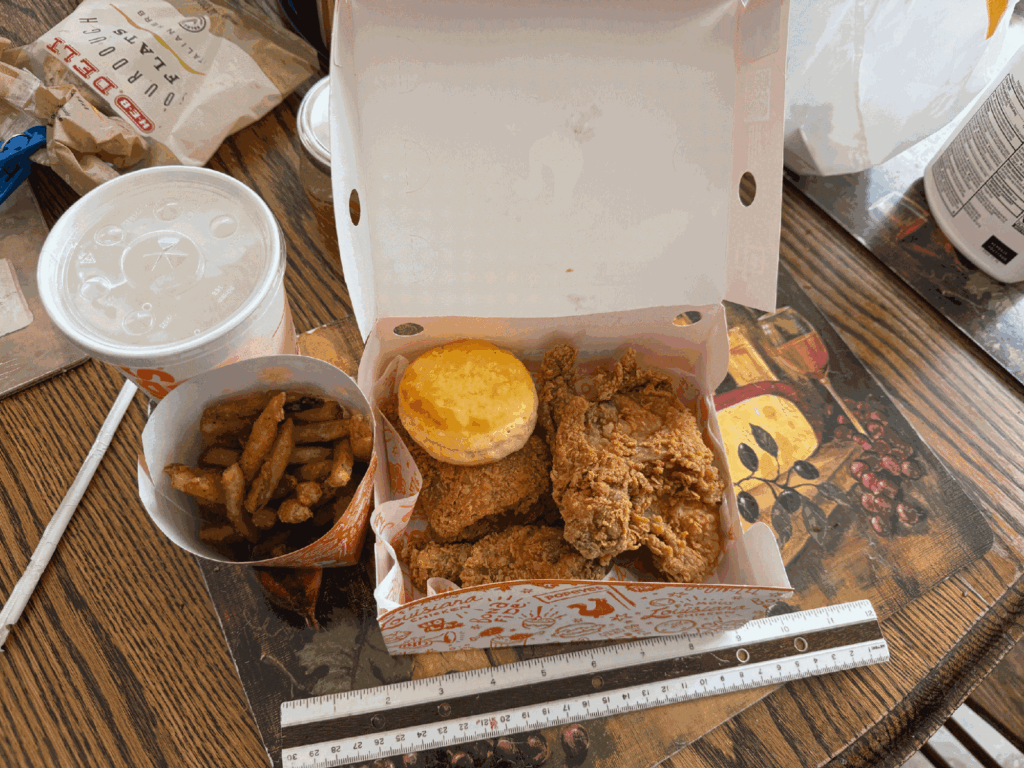
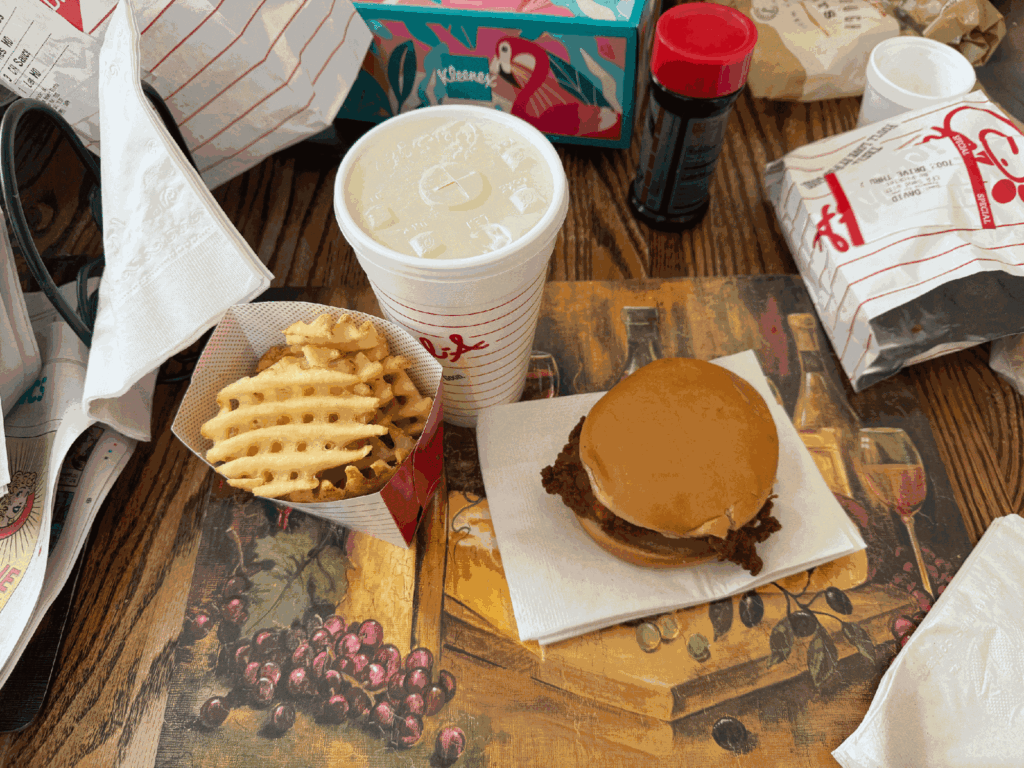
It was finally time to try the chicken. When we pulled out the meal, it was obvious that the fried chicken was the main component. The fried chicken was also visibly bigger than the karaage. I measured their dimensions. The Popeye’s chickens were: 3.5×5 x 1.5 inches, 4.1 x 1.5 x 2 inches, and 3.5 x 3.5 x 2 inches. The Chick-fil-A sandwich was roughly a circle with a diameter of 2.75 inches, and was around 3 inches thick. Both meals came with fries and a soda. After tasting, I felt like the Popeye’s chicken had thicker breading than the Chick-fil-A sandwich, and the Chick-fil-A sandwich had much thicker breading than the karaage. I decided to eat the rest of the Popeye’s chicken and the fries, and found the meal very filling. I was not able to finish the third piece of chicken. My brother was able to finish the rest of the Chick-fil-A sandwich and the fries; I found it somewhat ironic that the medium fries were seemingly larger than the sandwich itself.
Differences in Portion Size and Meal Composition
When comparing karaage to American fried chicken, the difference in portion size of the fried foods stood out to me. When ordering the American fried chicken, I realized how normalized it was to consume other unhealthy foods alongside fried chicken in this country. French fries are obviously another form of fried food and thus are unhealthy, and soda consumption is associated with weight gain, diabetes, and heart disease. This made me wonder what fried foods in Japan are eaten with. I began my search with the description of the Karaage recipe I had followed for my project. The authors recommended it to be served alongside rice or in bento boxes (which would have rice and other side dishes). Even more curiously, they refer to the karaage as a side dish.
This classification made me interested in the general composition of a Japanese meal. The basic structure of a Japanese meal, referred to as ichijū sansai (one soup, three dishes), consists of rice, soup, a main dish, and two sides. The main dish tends to be protein rich, while the sides tend to be vegetables and high in fiber. As a result, the individual portions tend to be smaller. Under this framework, karaage would likely actually be a “main dish,” but eaten in smaller portions and alongside healthier foods. Since the Japanese diet is overall healthier than the American diet (which in itself reduces the negative effects of fried food consumption), I would not be surprised if Japanese fried food was consumed alongside healthier sides as well.
Within the recipes I referenced, half presented the final product solo. The other half presented the chicken alongside rice, and salad composed of bell peppers, lettuce and tomato. While these things are much healthier than french fries and soda, they did not seem to follow ichiju sansai as usually only one side was included. When looking up “からあげは通常、何と一緒に食べるものですか” (what do you usually eat karaage with, translated by DeepL), the top result was a link to recipes for a variety of salads, containing fruits and vegetables such as seaweed, green beans, cucumber, lettuce, tomato, and radishes. The penultimate top result said that plenty of vegetables and soup were recommended to balance out the fried chicken, which seemed more aligned to ichiju sansai.
I attempted to put this idea further to the test, and googled karaage, tonkatsu, and tempura (the most popular fried foods in Japan) in Japanese to see how often side dishes would appear and what the side dishes were. To see if the context of the fried food changed anything, I also appended the terms “konbini,” “izakaya,” or “meal” to each of the fried foods and repeated the search. For comparison, I also googled fried chicken in English, and appended what I viewed as the English equivalent (fast food and clubhouse & grill) when necessary. Since izakaya are casual pubs that serve food alongside drinks, I thought that they were roughly similar to Clubhouse & Grill restaurants, which are known for being somewhat casual, social, and also serving food and alcohol at a bar. Konbini seems to offer cheap and relatively unhealthy foods, which I thought made fast food a rough American equivalent. The results are observable below:
|
No extra term |
Konbini / Fast food |
Izakaya / Clubhouse & Grill |
Meal |
|
|
Karaage |
50% solo, 50% lettuce and tomato |
Solo only |
75% solo, 25% lettuce + tomato |
Ichiju Sansai |
|
Tonkatsu |
Always with lettuce |
With Rice |
Usually with lettuce, occasional Ichiju Sansai |
Ichiju Sansai |
|
Tempura |
Always with fried veggies as part of the dish. |
25% shrimp and 75% with fried veggies |
With fried veggies, occasional Ichiju Sansai |
Ichiju Sansai |
|
(In English) Fried Chicken |
Solo only |
With Fries |
50% Solo, 50% French Fries |
50% Various sides, 45 % Solo, 5% French Fries |
While my little experiment is far from scientific and includes lots of approximations, I do think it does provide valuable insight. Japanese fried food tends to be eaten overall alongside healthier side dishes than their American counterparts (i.e. french fries). While fried food is not always eaten according to ichiju sansai, the fact that it appeared unanimously when I added “meal” and occasionally when I added “izakaya” does indicate to me that the format is still widespread within Japan. For various sides found in fried chicken meals, I am referring to the sides found in a typical western dinner, which are carbohydrates and some greens. From a purely visual standpoint, I also noticed that the fried dishes tend to appear overall smaller, and take up less space on the plate.
Konbini offers much more than just karaage. When I looked at the Japanese website for 711, I found that they offered more kinds of food than I could reasonably list out, but include salads, onigiri, sushi, noodles, sandwiches, pastries and pasta. I also came across websites that instructed people how to eat a balanced meal using convenience store foods, which demonstrated to me that a meal consisted of anywhere between 2-4 convenience store food items, a count which indicates that convenience store food items are not meant to be eaten singly. Coffee, tea, and water appear to be the most popular drinks ordered at konbini, which are healthier than soda. Put together, this indicates that karaage and other fried foods bought at konbini are eaten alongside a wider variety of things than in comparison to fried chicken in America. Since fried chicken is most eaten alongside french fries and soda in America, the diversity of foods (and drinks) karaage can be eaten with in Japan likely results in an overall healthier meal.
I decided to further investigate the potential differences in portion sizes by re-examining the seven karaage recipes I had found. Due to the fact that some of my recipes are youtube videos, I was not able to fully identify if all of my recipes were meant for one or two people. Also, not all of the physically written videos specified if the meal was meant for one or two people. Two recipes indicated that 250–350g of chicken was meant for 2 people, while 1 stated that 350g was appropriate for one person. Notably, American recipes for fried chicken included 2–4 pounds of chicken (900–1.8 thousand grams), much higher than found in the Japanese recipes.
I also decided to see what sizes of meat were normal to buy from grocery stores in Japan. For chicken, pork, and beef, I noticed that a majority of the products were between 200 and 500g of meat. While I was able to find one or two products selling 700g of meat, they appeared to be much rarer. To put these portions into perspective, the 800g chicken I bought was the average size of chicken within the store. When looking at sizes of meat available at stores in the United States, the sizes of meat available in the packages tended to vary from 500g to 1000g.
While this investigation is also far from scientifically sound, I do believe this still indicates that consuming larger amounts of meat is more normalized in the United States than in Japan. By extension, it is more normalized to eat larger amounts of fried foods in the United States in comparison to Japan. Japanese fried food is also eaten with healthier sides than American fried food. A large reason why Japanese cuisine might be healthier than American cuisine might then not have much to do with the Japanese fried food itself, but with the quantity and combination with which it is eaten.
Thickness of Breading + Frying Time
Another aspect that I noticed in my comparison between Japanese and American fried chicken is the thickness of the breading. My recipe is not an exception, as karaage is generally known to have a thin, crispy crust. tempura and tonkatsu also tend to have thinner crust. This is reflected in the ingredients used in the breading, Potato starch and / or cake flour. As an American, I have never heard of using potato starch or cake flour for fried food. Instead, all-purpose flour is most commonly used, which is thicker than cake flour and potato starch. From what I can tell, there is unfortunately very limited research comparing the oil absorption rates of potato starch and cake flour starch to all-purpose flour. However, it is generally acknowledged that thinner crust tends to result in less oil absorption. Therefore, Japanese fried foods with thinner crust may absorb less oil and thus contain less fat than American fried foods.
Oil absorption is strongly associated with moisture loss that occurs within the fried food. Logically, this means that food fried for a shorter time will likely absorb less oil due to less of an opportunity for water moisture loss to occur. Frying times for Japanese recipes are surprisingly short. For karaage and tempura, I was not able to find any recipe that recommended frying for longer than five minutes. For tonkatsu, the recommended frying time tended to be around 7–8 minutes total. American fried foods tend to be fried for much longer: ranging from 5 minutes to 20 to even 30 minutes. The USDA even recommends frying chicken for 12–20 minutes. Chick-fil-A fries their chicken for 4–6 minutes, while Popeyes fries their chicken for 12 minutes. Raising Canes, another popular fast food chain, fries their chicken for about 4.5 minutes.
While the evidence is not clear, it is possible that the thin breading of Japanese fried food potentially makes it healthier. Japanese fried food is fried at similar times as certain fast-food restaurants, which in my opinion makes frying time an unlikely explanation for the difference in impact of fried foods in America and Japan.
Cooking Oil
The one and a half jars of cooking oil made me realize that cooking oil is also an ingredient for cooking fried chicken. As food is fried, it absorbs some of the cooking oil, quite literally making cooking oil an ingested ingredient. There are a variety of different kinds of cooking oils that have different compositions of saturated fatty acids (SFA), monounsaturated fatty acids (MUFA), and polyunsaturated fatty acids (PUFA). For example, corn has 13.6% SFA, 29% MUFA, and 57% PUFA, while coconut oil has 92% SFA, 6% MUFA, and 2% PUFA. Generally, it is acknowledged that monounsaturated and polyunsaturated fats are healthy for the body, while unsaturated fats are unhealthy. This means that the cooking oils used to fry food have an impact on how healthy it is.
Different kinds of cooking oils are popular in the United States in comparison to Japan. Within North America, over 50% of vegetable oil sold is soybean oil. The second most popular oil is canola, which represents under 20% of total sales. Chick-fil-A states that they fry all of their chicken in Peanut oil. In Japan, canola oil is preferred over soybean oil: over 890,000 tons of canola oil were imported, while 540,000 tons of soybean oil was imported. Soybean oil has 16% SFA, 23% MUFA, and 60% PUFA; canola has 7% SFA, 64% MUFA, and 28% MUFA; Peanut oil has 17% SFA, 49% MUFA, and 34 % PUFA. This preference for Canola cooking oil in Japan, then, might make Japanese fried food a little bit healthier than in America.
Reusing cooking oils can result in the production of carcinogenic and otherwise unhealthy compounds within the oil, and also makes the cooking oil more acidic. In Japan, cooking oils can no longer be reused if they are above a certain acidity. As a result, in restaurants, cooking oils have to be changed once a week in order to comply with this law. However, cooking oils might be exchanged more often than that—when somebody in a Japanese forum said they exchanged their cooking oil at their restaurant once a week there were several responses from individuals who were disgusted by this and said that cooking oil should be exchanged daily. Exchanging oil on a weekly basis, a commenter said, seemed almost unheard of. Meanwhile, the US does not have an explicit limit when it comes to the chemical properties of the oil, but instead must be replaced if they become too darkly colored from reuse. While some fast-food workers online state they do swap their oil out on a weekly basis, several others do it every other week or even less frequently. Exchanging oil once a week seemed normal. This difference in attitudes hints that cooking oils tend to be exchanged more frequently in Japanese restaurants than in American ones, which might make Japanese fried food healthier in comparison.
Conclusion
Through my comparison of American and Japanese fried foods, I have found several factors about Japanese fried food that help reduce the harmful effects of fried food. Japanese fried dishes has a smaller portion size and is usually eaten with sides that are healthier than in America. This is a manifestation of the fact that the Japanese diet is overall healthier than their American counterparts. The breading is generally thinner, which can reduce the oil absorption that occurs during frying. Japan also has a preference for healthier cooking oils and restaurants tend to exchange cooking oil at a more frequent pace.
Of course, fried food alone does not alone explain the difference in rates of obesity and diet-related diseases. As stated before, the Japanese diet is generally much healthier than the American diet. Surveys and research have found that Japanese citizens walk much more than American citizens. This is partially due to Japan having urban planning that is more friendly to pedestrians and the availability of public transportation and parks. Japan has universal healthcare, allowing for check-ins that have been found to reduce obesity. While my project did not focus on these topics, these factors are undeniably reasons for why obesity rates are lower in Japan than in the United States, regardless of fried food consumption.
I am overall satisfied with how my project turned out. I was initially somewhat concerned about how useful cooking karaage would be, but my concerns were unfounded. There is a difference between reading about something and actually doing it yourself. Cooking karaage made me aware of the difference in portion size and the importance of ingredients and cooking oil. I also greatly enjoyed cooking and am proud of myself for making the karaage, even if I messed up a little bit. Even though I have ordered fast food before, ordering Chick-fil-A and Popeyes was still a very educational experience—most notably, it made me realize the prevalence of french fries and sodas in fast food orders. I do wish that I was somehow able to find more scientific sources to back up some of my claims, find more objective ways to cook a “representative” karaage, and find out what sides are most eaten with fried foods. However, I do think that I was very thorough with my investigation, and I do not think there is a true way to objectively quantify such things (especially one that is feasible for a college student), so I still am very happy with the project.
Bibliography
Abrante-Pascual, Susana, Barbara Nieva-Echevarría, and Encarnacion Goicoechea-Oses. “Vegetable Oils and Their Use for Frying: A Review of Their Compositional Differences and Degradation.” Foods 13, no. 24 (2024): 4186. https://doi.org/10.3390/foods13244186.
“ALDI Grocery Stores – Quality Food. Everyday Low Prices.” Accessed March 28, 2026. https://www.aldi.us/store/aldi/s?k=chicken.
Askinasi, Rachel. “I Went behind the Scenes at Chick-Fil-A to See How Its Famous Chicken Sandwich Is Made — and I Learned the Whole Process Is Really a Race against the Clock.” Business Insider. Accessed March 28, 2026. https://www.businessinsider.com/how-chick-fil-a-chicken-sandwich-is-made-2019-1.
“Average Food Cost in Japan 2026 — Complete Guide.” February 17, 2026. https://www.japantripcost.com/blog/average-food-cost-japan.
Bassett, David R. Jr, Holly R. Wyatt, Helen Thompson, John C. Peters, and James O. Hill. “Pedometer-Measured Physical Activity and Health Behaviors in U.S. Adults.” Medicine & Science in Sports & Exercise 42, no. 10 (2010): 1819. https://doi.org/10.1249/MSS.0b013e3181dc2e54.
Brischke, Jade. “To Eat or Not to Eat (Konbini Food?), That Is the Question!” Get Hiroshima, July 10, 2016. https://gethiroshima.com/features/konbini-food-healthy-or-unhealthy/.
Chen, Namiko Hirasawa. “Discover Ichiju Sansai: The Japanese Formula for Balanced Meals (一汁三菜 ).” Just One Cookbook, October 23, 2025. https://www.justonecookbook.com/ichiju-sansai/.
Christopher Kimball’s Milk Street | Recipes, TV and Cooking Tips. “Japanese Fried Chicken.” Accessed March 28, 2026. https://www.177milkstreet.com/stories/japanese-fried-chicken.
Cookpad. “そうめん天ぷら定食♪ by ミント15♪.” July 23, 2023. https://cookpad.com/jp/recipes/21590839.
Cookpad. “めっちゃジューシー♪鶏の唐揚げ by ぱんこ625.” November 30, 2008. https://cookpad.com/jp/recipes/22640981.
Corporation L. Y. “飲食店の油の交換頻度ってどのくらいでしょうか?お店によると思いますが、、ちなみに8年前働いてたとんかつサボテンは1週間に1度…” Yahoo!知恵袋. Accessed March 28, 2026. https://detail.chiebukuro.yahoo.co.jp/qa/question_detail/q12297628152?fr=smp_ogp_other.
Dave, Jayna M., Lawrence C. An, Robert W. Jeffery, and Jasjit S. Ahluwalia. “Relationship of Attitudes Toward Fast Food and Frequency of Fast-Food Intake in Adults.” Obesity 17, no. 6 (2009): 1164–70. https://doi.org/10.1038/oby.2009.26.
“Deep Fat Frying and Food Safety | Food Safety and Inspection Service.” Accessed March 28, 2026. http://www.fsis.usda.gov/food-safety/safe-food-handling-and-preparation/food-safety-basics/deep-fat-frying.
“Deep Fried Foods.” Accessed March 28, 2026. https://www.japan-guide.com/forum/quereadisplay.html?0+77695.
“DeepL Translator | World’s Most Accurate Translator.” Accessed March 28, 2026. https://www.deepl.com.
“Difference in Grating vs. Mincing : R/Cooking.” Accessed March 28, 2026. https://www.reddit.com/r/Cooking/comments/1q8j54w/difference_in_grating_vs_mincing/.
“Does Chick-Fil-A Use Peanut Oil? | Chick-Fil-A.” June 2, 2025. https://www.chick-fil-a.com/customer-support/our-food/nutrition-and-allergens/does-chick-fil-a-use-peanut-oil.
Dunford, Nurhan. Industrial Deep Fat Frying. n.d.
“Eating More; Enjoying Less.” Pew Research Center, April 19, 2006. https://www.pewresearch.org/social-trends/2006/04/19/eating-more-enjoying-less/.
FNNプライムオンライン. “【揚げ物に関する調査】好きな揚げ物は「トンカツ」「鶏の唐揚げ」「エビフライ」「てんぷら」「コロッケ」が各60%台。男性50~70代では「トンカツ」、女性10・20代では「フライドポテト」が1位.” July 31, 2025. https://www.fnn.jp/articles/-/910224.
Food52. “Do I Really Need to Bake With Cake Flour?” June 17, 2022. https://food52.com/story/27490-cake-flour-vs-all-purpose-flour.
Gabriel, Ana San, Kumiko Ninomiya, and Hisayuki Uneyama. “The Role of the Japanese Traditional Diet in Healthy and Sustainable Dietary Patterns around the World.” Nutrients 10, no. 2 (2018): 173. https://doi.org/10.3390/nu10020173.
Gutiérrez-Silva, Glenda, Francisco Vásquez-Lara, Nina G. Heredia-Sandoval, and Alma R. Islas-Rubio. “Effect of High-Protein and High-Fiber Breaders on Oil Absorption and Quality Attributes in Chicken Nuggets.” Foods 12, no. 24 (2023). https://doi.org/10.3390/foods12244463.
Hari, Johann. “The Land That Doesn’t Need Ozempic.” TIME, May 9, 2024. https://time.com/6974579/japan-food-culture-low-obesity/.
Holly, Erickson. “Chicken-Fried-Chicken.” The Modern Proper, October 25, 2025. https://themodernproper.com/chicken-fried-chicken.
“I Am a Raising Canes Employee, Going on Two Years. AMA! : R/Fastfood.” Accessed March 28, 2026. https://www.reddit.com/r/fastfood/comments/7okp0t/i_am_a_raising_canes_employee_going_on_two_years/.
Joe, Chris. “Easy Fried Chicken (VIDEO).” CJ Eats Recipes, October 2, 2025. https://cjeatsrecipes.com/easy-fried-chicken/.
Katayama, Akiko. “Konbini: Why Are People So Obsessed With Japanese Convenience Stores?.” Forbes. Accessed March 28, 2026. https://www.forbes.com/sites/akikokatayama/2025/12/29/konbini-what-is-so-special-about-japanese-convenience-stores/.
Kenneth R, Feingold. “Table 3. [Fat Composition of Oils, Lard, Butter, and Margarine].” Text. MDText.com, Inc., March 31, 2024. https://www.ncbi.nlm.nih.gov/books/NBK570127/table/lipid_diet_cardiov.T.fat_composition_of/.
Klein, Danny. “Chick-Fil-A Served 527 Million Chicken Sandwiches in 2022.” QSR Magazine, May 23, 2023. https://www.qsrmagazine.com/operations/chick-fil-served-527-million-chicken-sandwiches-2022/.
Klein, Danny. “Chick-Fil-A’s Sales Surpassed $22 Billion in 2024.” QSR Magazine, April 2, 2025. https://www.qsrmagazine.com/story/chick-fil-as-sales-surpassed-22-billion-in-2024/.
Koh Kentetsu Kitchen【料理研究家コウケンテツ公式チャンネル】. Home-Style Fried Chicken. 2020. 15:41. https://www.youtube.com/watch?v=joWqjVNoIZc.
Liu, Ann G., Nikki A. Ford, Frank B. Hu, Kathleen M. Zelman, Dariush Mozaffarian, and Penny M. Kris-Etherton. “A Healthy Approach to Dietary Fats: Understanding the Science and Taking Action to Reduce Consumer Confusion.” Nutrition Journal 16 (August 2017): 53. https://doi.org/10.1186/s12937-017-0271-4.
make, Allrecipes Test Kitchen The Allrecipes Test Kitchen staff are a team of culinary pros who, vet recipes using only equipment you’d find in a home kitchen Staff credentials vary but include training at the Culinary Institute of America; kitchen stints in fine dining restaurants;, and countless hours in the test kitchen itself Meet the Allrecipes Test Kitchen. “Crispy Fried Chicken.” Allrecipes. Accessed March 28, 2026. https://www.allrecipes.com/recipe/8805/crispy-fried-chicken/.
Matsumoto, Marc. “Shio Karaage (Japanese Salt Fried Chicken).” Norecipes – Elevating Everyday Meals, June 5, 2022. https://norecipes.com/shio-karaage-fried-chicken/.
MICHELIN Guide. “The History of Tempura.” Accessed March 28, 2026. https://guide.michelin.com/hk/en/article/features/tempura_en.
“North America Vegetable Oils Market Size, Share, Forecast 2026.” Accessed March 28, 2026. https://www.fortunebusinessinsights.com/industry-reports/north-america-vegetable-oils-market-101012.
Ohyagi, Noboru, Yomi Watanabe, Yoshiko Sugita-Konishi, Takayuki Morita, and Mariko Mochizuki. “Extending the Lifetime of Frying Oil through Optimization of Fryer Cleaning.” Journal of Oleo Science 73 (January 2024): 1035–43. https://doi.org/10.5650/jos.ess23240.
“Online Grocery Delivery and Pickup | Pharmacy | Stop & Shop.” Accessed March 28, 2026. https://stopandshop.com/browse-aisles/categories/1/categories/1563/categories/2855-chicken.
Organization, Japan National Tourism. “Izakaya Dining Guide | Guide | Travel Japan – Japan National Tourism Organization (Official Site).” Travel Japan. Accessed March 28, 2026. https://www.japan.travel/en/guide/dinner-at-a-japanese-tavern/.
Oudat, Qutaibah, Sarah E. Messiah, and Alia Dawlat Ghoneum. “A Multi-Level Approach to Childhood Obesity Prevention and Management: Lessons from Japan and the United States.” Nutrients 17, no. 5 (2025): 838. https://doi.org/10.3390/nu17050838.
“People Who Have Worked in Fast Food, How Often Do They Change the Oil in the Fryers? : R/AskReddit.” Accessed March 28, 2026. https://www.reddit.com/r/AskReddit/comments/dxyaxg/people_who_have_worked_in_fast_food_how_often_do/.
“Popeyes.” Accessed March 28, 2026. https://www.popeyes.com/.
“QSR 50 2025: Top Fast-Food Chicken Chains, Ranked by Sales – QSR Magazine.” Accessed March 28, 2026. https://www.qsrmagazine.com/story/qsr-50-2025-top-fast-food-chicken-chains-ranked-by-sales/.
Sagawa, Naoko, Bonny Rockette-Wagner, Koichiro Azuma, et al. “Physical Activity Levels in American and Japanese Men from the ERA-JUMP Study and Associations with Metabolic Syndrome.” Journal of Sport and Health Science 9, no. 2 (2020): 170–78. https://doi.org/10.1016/j.jshs.2019.09.007.
Sutherland-Namako, Amber. “How To Decide If Your Recipe Needs Minced Or Grated Ginger.” Chowhound, August 16, 2025. https://www.chowhound.com/1936692/grated-minced-ginger-compared/.
Takeuchi, Masato, Tomohiro Shinozaki, and Koji Kawakami. “Universal Health Checkups and Risk of Incident Diabetes and Hypertension.” JAMA Network Open 7, no. 12 (2024): e2451813. https://doi.org/10.1001/jamanetworkopen.2024.51813.
Taste of Japan | Japanese Cuisine Information Site. “What Is Ichiju-Sansai?” Accessed March 28, 2026. https://japan-food.jetro.go.jp/en/topics/detail/134.html.
Thin Tonkatsu 豚カツ (Thin Japanese Breaded Pork) – With a Glass. November 19, 2012. https://www.withaglass.com/?p=11964.
“This Is What My Manager Considers Acceptable for Our Fryers. : R/McDonaldsEmployees.” Accessed March 28, 2026. https://www.reddit.com/r/McDonaldsEmployees/comments/1balit9/this_is_what_my_manager_considers_acceptable_for/.
Tsugane, Shoichiro. “Why Has Japan Become the World’s Most Long-Lived Country: Insights from a Food and Nutrition Perspective.” European Journal of Clinical Nutrition 75, no. 6 (2021): 921–28. https://doi.org/10.1038/s41430-020-0677-5.
Valme, Alexa. “What’s The Best-Selling Item At Chick-Fil-A?” Daily Meal, March 25, 2025. https://www.thedailymeal.com/1807192/chick-fil-a-best-selling-menu-item/.
Vartanian, Lenny R., Marlene B. Schwartz, and Kelly D. Brownell. “Effects of Soft Drink Consumption on Nutrition and Health: A Systematic Review and Meta-Analysis.” American Journal of Public Health 97, no. 4 (2007): 667–75. https://doi.org/10.2105/AJPH.2005.083782.
Vegeday. “とんかつレシピ!プロ直伝サクッと食感の作り方&野菜付け合わせ.” Accessed March 28, 2026. http://www.kagome.co.jp/vegeday/eat/202309/14091.html.
Veronese, Nicola, Brendon Stubbs, Marianna Noale, et al. “Fried Potato Consumption Is Associated with Elevated Mortality: An 8-y Longitudinal Cohort Study.” The American Journal of Clinical Nutrition 106, no. 1 (2017): 162–67. https://doi.org/10.3945/ajcn.117.154872.
What Is Tempura – Shoku Japanese Restaurant. Uncategorized. October 2, 2025. https://shokujapaneserestaurant.com.au/what-is-tempura/.
What Is the Meaning of Bar and Grill? Phuket Dining Tips. July 14, 2025. https://pizzagrillphuket.com/blog-what-is-bar-and-grill/.
“Why Has Japan Become the World’s Most Long-Lived Country: Insights from a Food and Nutrition Perspective – Google Search.” Accessed March 28, 2026. https://www.nature.com/articles/s41430-020-0677-5.
Yahoo Life. “Here’s Why Popeyes Marinates Its Fried Chicken For 12 Hours.” December 22, 2025. https://www.yahoo.com/lifestyle/articles/heres-why-popeyes-marinates-fried-111700987.html.
Yatsuya, Hiroshi, and Shoichiro Tsugane. “What Constitutes Healthiness of Washoku or Japanese Diet?” European Journal of Clinical Nutrition 75, no. 6 (2021): 863–64. https://doi.org/10.1038/s41430-021-00872-y.
Zimmern, Andrew. “How to Make Perfect Fried Chicken at Home.” Andrew Zimmern, n.d. Accessed March 28, 2026. https://andrewzimmern.com/recipes/how-to-make-perfect-fried-chicken-at-home/.
“から揚げに合う献立はこれ!付け合わせ・副菜の人気レシピ特集! | キッコーマン | ホームクッキング.” Accessed March 28, 2026. https://www.kikkoman.co.jp/homecook/theme/popular/karaage-side.html.
“カリッとジューシーな定番の味 から揚げの基本レシピ | とっておきレシピ | キユーピー.” Accessed March 28, 2026. https://www.kewpie.co.jp/recipes/basicokazu/okazu01/.
きじまごはん 【料理家きじまりゅうた公式チャンネル】. 人気レシピを簡単に【鶏むね肉の から揚げ 作り方】衣はザクザク マヨネーズ効果でジューシー唐揚げ. 2024. 7:00. https://www.youtube.com/watch?v=lC3NtE6cei4.
キッコーマン ホームページ. “プロに教わる鶏の唐揚げ(から揚げ)のレシピ・作り方【人気の定食屋・菱田屋さん直伝】 | キッコーマン | ホームクッキング.” Accessed March 28, 2026. https://www.kikkoman.co.jp/homecook/tsushin/tips0074/.
ジューシーで奥深い味わい!みんな大好き揚げ物料理トップ10! | テンポスフードメディア. May 18, 2025. https://foodmedia.tenpos.com/newstrend/36235/.
セブン‐イレブン. “商品のご案内.” Accessed March 28, 2026. https://www.sej.co.jp/products.html.
デリッシュキッチン. “カリッとジューシーに仕上がる!失敗しない唐揚げのレシピ.” Accessed March 28, 2026. https://delishkitchen.tv/recipes/167612989870965228.
デリッシュキッチン. “副菜から汁物まで!唐揚げに合う献立レシピまとめ.” Accessed March 28, 2026. https://delishkitchen.tv/articles/1524.
“とんかつ【衣サックリ、肉しっとりの人気味】(基本の和食)のレシピ・つくり方 | キッコーマン | ホームクッキング.” Accessed March 28, 2026. https://www.kikkoman.co.jp/homecook/search/recipe/00055169/.
ヒガシマル醤油 公式チャンネル. 決定版!毎日でも食べられる!さくっとジューシー!大原千鶴のわが家のからあげ. 2025. 0:30. https://www.youtube.com/watch?v=IWe1TXpS7_4.
プレスリリース・ニュースリリース配信シェアNo.1|PR TIMES. “コンビニでよく買う飲み物200人に聞きました!3位「水」、2位「お茶・紅茶」!1位は何?.” April 25, 2024. https://prtimes.jp/main/html/rd/p/000000100.000135215.html.
プレスリリース・ニュースリリース配信シェアNo.1|PR TIMES. “【揚げ物に関するアンケート調査】揚げ物を食べる頻度は「週2~3回」「週1回」がボリュームゾーン。調理法・準備方法は「自分や家族などの手作り」「調理済みのもの・惣菜」が各5~6割.” August 5, 2019. https://prtimes.jp/main/html/rd/p/000000764.000007815.html.
“みんながコンビニで買ったフード・ドリンクは? 【2023Oggi.Jpアワード】.” Oggi.Jp, December 22, 2023. https://oggi.jp/7102205.
東京ガス ウチコト. “【アンケート調査】家庭で「揚げ物」を食べる頻度は?【東京ガス都市生活研究所】.” Accessed March 28, 2026. https://uchi.tokyo-gas.co.jp/topics/4626.
株式会社ニチレイフーズ. “コンビニで栄養バランスの良い食事をとるには?【管理栄養士監修】.” Accessed March 28, 2026. https://wellness.nichirei.co.jp/contents/detail/_64.
“植物油と栄養|一般社団法人 日本植物油協会.” Accessed March 28, 2026. https://www.oil.or.jp/kiso/eiyou/eiyou02_02.html.
楽天全国スーパー. “鶏もも肉|西友ネットスーパー|楽天全国スーパー.” Accessed March 28, 2026. https://netsuper.rakuten.co.jp/seiyu/search/320273/.
済生会熊本病院社会福祉法人 恩賜財団. “コンビニご飯で健康的な食生活 | 健康のキホン | 済生会熊本タイムズ | 済生会熊本病院.” 社会福祉法人 恩賜財団 済生会熊本病院, September 7, 2023. https://sk-kumamoto.jp/sk_times/23296/.
白ごはん.Com:おもてなしから基本まで いちばん丁寧な和食レシピサイト. “天ぷらの基本のレシピ~衣・油・揚げ方まで~:白ごはん.Com.” Accessed March 28, 2026. http://www.sirogohan.com/recipe/tenpura/.
“第34号特別分析トピック︓我が国と世界の油脂をめぐる動向.” Ministry of Agirculutre, Forest, and Fisheries, n.d. Accessed March 28, 2026. https://www.maff.go.jp/j/zyukyu/jki/j_rep/monthly/attach/pdf/r6index-8.pdf.
“鶏肉(価格(高い順))|トキハオンラインショップ.” Accessed March 28, 2026. https://www.tokiwa-portal.com/shop/r/r202530_sspd/.