Project Goals & Personal Significance:
“Gyotaku,” or the traditional Japanese art form of fish printing, has become a recent passion of mine. I discovered and have been practicing this creative medium for the past two years, primarily in the summer, when I have enough free time to fish frequently. This interest in gyotaku comes from a few unique aspects of my life—being part Japanese and admiring Japanese culture, having a lifelong love for fishing, and being a creative and curious person. I was first introduced to gyotaku art a few years ago when I was visiting Hawaii. I saw some beautiful pieces that my uncle made, and I visited the shop of an artist named Naoki, whose work fascinated me. I admire Naoki’s world-renowned art, gyotaku business, and his style of painting with natural colors and hyper realism. I spent this past summer in Hawaii doing a mechanical engineering internship, and I spent lots of time doing gyotaku for local fishermen. Many of the fishermen who commissioned gyotaku from me compared my work to Naoki’s, which was a huge honor and compliment that I am very proud of, and it speaks to the level of my novice artwork. I now have aspirations of potentially pursuing a career in gyotaku art, maybe later in retirement, but I will continue perfecting my craft in this fascinating art form, at least as a hobby, for the time being.
By choosing this topic of gyotaku for my project, I had two main goals in mind for my research on Japanese gyotaku fish prints and the unique gyotaku piece I would be making. Firstly, I wanted to create a gyotaku piece that was more authentic than what I tend to make, using more traditional materials and techniques that I have not yet attempted in my short time as a gyotaku artist. Secondly, I hoped to learn more about the art form and its significance to Japanese culture as a whole. With these two elements, I aimed to connect the technical aspects of creating an authentic gyotaku piece with the underlying cultural implications of fish and artistic practices.
Historical Background of Gyotaku:
A big part of settling on this topic for the project comes from the fact that I really love this art. But before this project, I knew next to nothing about the historical context of gyotaku. With my Japanese family background and desire to improve as an artist, having a solid understanding of gyotaku and its origins was necessary. This project has been the perfect opportunity, and I knew it would be ever since I saw the syllabus of the class on the first day.
Oftentimes, when I tell people I am a gyotaku artist, I am met with the question: so what is gyotaku? I’ve never had a good answer to this. I usually just respond: Gyotaku is a Japanese art form where you print fish on paper. While this is not wrong, this claim lacks some of the important historical reasons for the creation of gyotaku. Through reading Peter Moyle’s book, A Life among Fishes: The Art of Gyotaku, I gained a better grasp of the history behind gyotaku. Though much of the book consists of images of gyotaku, the writing dives into important aspects of the historical context of the art form. Moyle illustrates how the character 魚 means “fish,” and the sound is “gyo.” The other character 拓 means “stone monument rubbing” and its sound is “taku” (Moyle, 3). I was not at all surprised by the meaning of the character “gyo,” but I was intrigued by “taku,” as I had never heard of stone monument rubbings before. Looking more into these stone rubbings, I see the similarities with gyotaku fish printing: both involve creating an impression of a raised surface and transferring it onto paper with ink. Moyle goes into how the gyotaku involves applying sumi ink on a fish and then carefully applying a layer of rice paper over the top and carefully rubbing to take an imprint of all the fine details of the fish.

As far as why gyotaku was created, I had predictions before reading this book, including some origins similar to what Moyle describes. Historically, gyotaku was a technique used by fishermen to “preserve a true record of the fish caught…the exact size and species of the game taken by the sports fisherman” (Moyle, 4). This is not a surprise to me at all. Being an avid fisherman myself, I know how much pride a fisherman feels when they catch a prized fish. This sense of pride is one I hold onto deeply, especially when talking to fellow fishermen. In fishing friend groups, we use the term “PB” standing for personal best to refer to our prized catches, and the length and weight are important measures when talking about our PB’s. Nowadays, it is easy to take out our smartphones and take a picture of our fish within seconds, which forever preserves a record and image of the fish. One can even include a scale or tape measure to legitimize the size of it. However, before cameras were normalized, a physical gyotaku print of a fish would be a great way to keep a permanent record of the true size of a fish. It is very eye-opening to me how the first gyotaku may not have been seen as an art form, but instead just a method of record-keeping for the preservation of fishing catches. Even today, a similar pattern of record keeping with fish is common, as many anglers often choose to do an actual taxidermy or, more commonly, artificial replica taxidermy to “mount” their prized catches to become a lasting piece to put on their wall and show off forever.
Later in Moyle’s book, he transitions to the modern perception of gyotaku as artistic expression. One part that really resonated with me is how gyotaku “presents a true creation by means of arrangement, material, and meaning” (Moyle, 5). The creative nature of gyotaku explains how it transitioned from a method of documentation into an art form. I feel the endless ways of composing a gyotaku piece allow the artist the ability to let their art tell a story. This can take many forms, but I see this “true creation” through the artist’s choice of color, orientation of the fish on the page, and the species of fish chosen. Moyle demonstrates how gyotaku was created for the simple reason of taking the imprint of a fish, but has evolved into an artistic medium where creativity and originality thrive, which is a key reason the art form of gyotaku appeals to me so much. I see this artistry most vividly in how every time I create a gyotaku print, it is something completely new. It is nearly impossible for me to ever make two pieces that are completely “identical,” which is so incredible.
Since I am a passionate fisherman, I want to just touch briefly on the importance of fish to Japan. Japan is an archipelago, it is surrounded by the ocean on all sides, so fish and seafood are central to the Japanese diet and culture. Because of my family’s strong roots in Hawaii, I have a good understanding of how limited resources are on an island, how expensive shipped-in goods are, and how fish and seafood are staple protein sources. The dependence on seafood is not only reflected in Japanese cuisine but also in the preparation and presentation of seafood. As a result, fish are not only a food source but a key part of Japanese culture and life, strengthening gyotaku’s importance in Japanese culture.
Artistic Process & New Techniques:
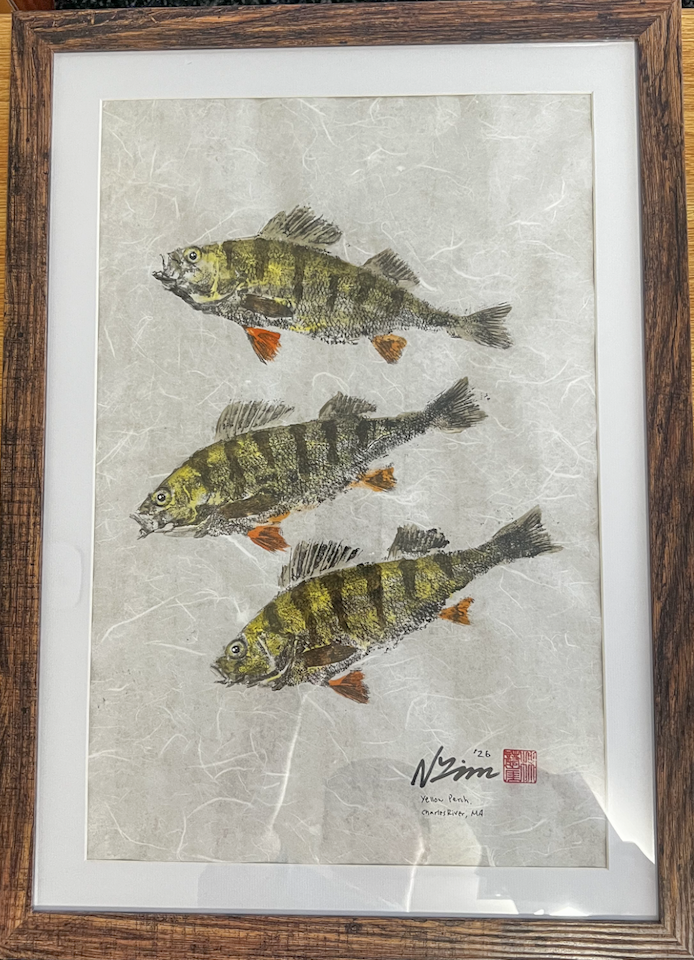
This past spring break, as the weather started to warm up, I spent many hours exploring eastern Massachusetts, where I live. With lingering winter weather, there was not much open water (most still covered in thick ice), so I found myself at a portion of the flowing Charles River in Cambridge, across from Harvard and MIT. I spent a whole afternoon at this spot and was lucky enough to catch a new species of fish that I had never had the chance to print—the Yellow Perch. I also caught multiple other species of fish, but I chose to bring the Yellow Perch home to print due to its striking yellow and orange hues and stark black stripes on its body. This contrast in color on a species always appeals to me as it gives a great model for my growing artistic abilities to follow. I thoroughly enjoy working with new species and challenging myself to try to replicate the colors and looks of a new and local species.
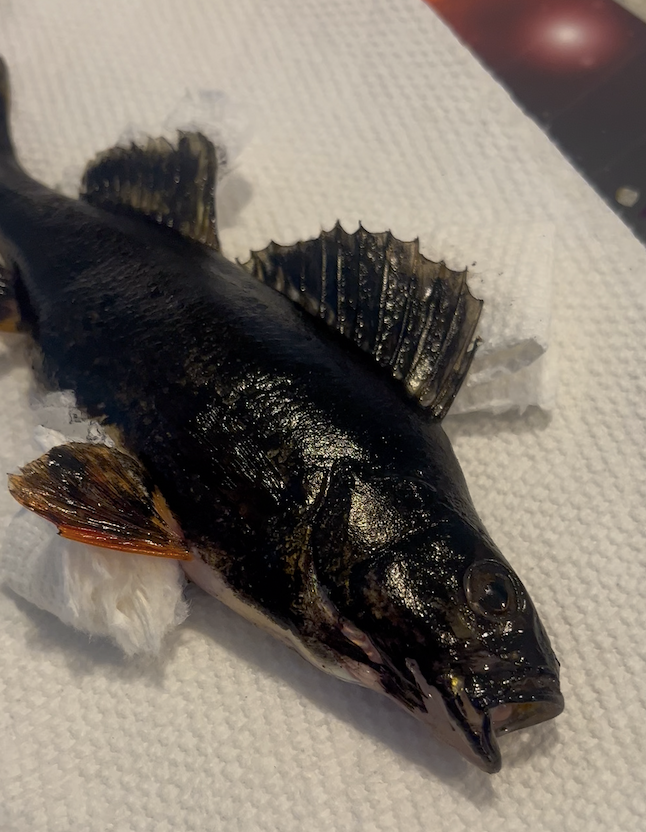
In creating this gyotaku piece, which I titled “School of Yellow Perch,” I intentionally wanted to try two new techniques that are part of the traditional Japanese style of gyotaku. The first technique is the usage of sumi ink. I usually just use water-based acrylic because of the convenience and cheap costs of this paint. However, in Moyle’s book, the style and importance of using sumi ink became abundantly clear to me. After seeing the results from both types of paints, the outcome of the print does not appear much different from when I use normal acrylic paint, but the meditative process of creating a high-quality, dark ink was evident. This process requires a “black ink stick—the Sumi— ground [on] a Suzuri, with the addition of a little water, to obtain black ink” (Moyle, 18). I did find grinding my own sumi ink, while time-consuming and maybe even a little bit unnecessary, allowed me to reflect on the process of gyotaku and the traditional styles of ink making and fish printing. Below is an image of the sumi ink applied to the perch before I applied the rice paper over it for the initial impression.
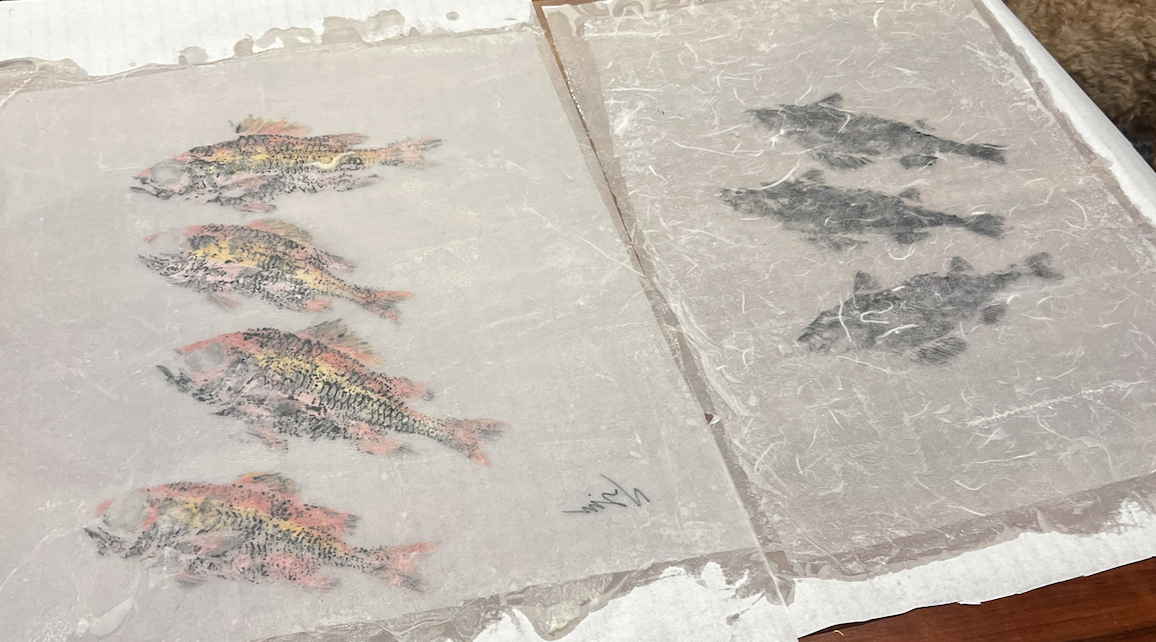
The second technique I chose to explore and undertake was the process of urauchi wet mounting. This process entails applying a homemade wheat-based glue on the original rice paper, then applying a layer of washi paper on the back to reinforce by smoothing the paper and thickening it. I found the drying stage takes around 24 hours for the two pages to fuse and become smooth and completely dry. This was an important step for me, as when I frame my pieces, the paper often appears wrinkled and sometimes rips in transportation since rice paper on its own is so thin and delicate. I found an interesting article from Pigment Tokyo, which highlights the importance of urauchi to Japanese artwork and has instructions for the process. Two major reasons for urauchi, which I believe are the most important, are how artwork on rice paper that did not have urauchi performed on it often have “wrinkles and sagging on its surface, and that makes it less enjoyable for the viewers” (Pigment Tokyo). Urauchi will no doubt be a technique I continue using to make my artwork look more professional and visually pleasing once framed. When first attempting urauchi, I had some issues finding a suitable surface to perform this gluing of paper—I later realized that glass is the most suitable material for adhesion, and I was using plexiglass, as it was all that I had. As I continue my journey as a gyotaku artist, I plan on perfecting this process to better preserve my gyotaku pieces in a more aesthetic and durable way that will look a lot more professional when framed. Below, I have included a picture of the drying stage of the urauchi process on two gyotaku pieces that I made (the one I made for this project is on the right side).
Now, I will transition into a portion of the project where I explore why gyotaku is so connected to Japan. I aim to make connections with different components of Japanese culture and relate them to my experiences of creating gyotaku and being an artist. I believe that gyotaku is significant to Japanese culture because it holds core values—respect for nature, an aesthetics based on “natural” presentations, and meditative artistic practices rooted in Zen and Shinto traditions.
Preservation and Presentation of Meat at Banquets
Exploring the method of meat presentation in traditional Japanese banquets provides an important counterpoint to understanding the purposeful, realistic display of dead animals. In Eric Rath’s “Ceremonial Banquets” from Food and Fantasy in Early Modern Japan, the connection between the lifelike display of animal species as an artistic creation and a deep reverence for nature is clear. Particularly of the hamori style of presentation, Rath notes how after a bird is cooked, there is a specific way that it is plated: “the feathered wings of the bird are reattached after the bird is cooked, giving the appearance that the cooked bird might revive and fly away” (Rath, 77). This method of “reattaching” the wings emphasizes the intentionality to presenting the bird in a realistic way, which I believe closely resembles the intentionality behind the composition of gyotaku. In the hamori style, the placement of the wings back onto the bird demonstrates the post-mortem reconstruction of an animal to signify its associations— flight, bountifulness, and the hunter’s ability to harness these powers. This whole idea of presenting an animal as alive, even though it is dead, parallels how in gyotaku, even though the fish is dead when the process of printing occurs, it will be “brought back to life.” An artist will carefully choose the position to orient the fish on the paper, flaring out all the fins to make it look alive and carefully drawing in details, such as the eye and stripes, making the fish look alive again on the paper. In both the hamori serving style and gyotaku, there is a strong pattern of the desire to maintain the “lifelike” look of an animal even while it is dead, preserving the animal in its last moments in a way that feels authentic.
I think it is also important to acknowledge other Japanese practices regarding food in relation to this topic. From my own personal experiences in my extended family, I have noticed a strong emphasis on and satisfaction with the aesthetic presentation of Japanese food. Whether it be beautifully made platters of sushi, with each nigiri uniformly made and positioned, or perfectly plated bowls of ramen, presentation is clearly valued within Japanese culture. Although hamori is no longer practiced in fine dining, contemporary equivalents can be seen with various presentations of fish: for sashimi, sometimes the flesh is presented on top of the carved fish which is made to look life-like. Or there are also grilled ayu, in which the small fish are skewered with a curve, then presented as though they were swimming in currents evoked by curved lines of salt. In terms of my family traditions, I have noticed that my mom and uncles, who are Japanese, care a lot about the plating of food, ensuring that everything is visually appealing, neat, and intentional. When I try to make sushi sometimes, and it turns out not looking so pretty, I am often met with snarks and unkind comments from my mom. Conversely, that chef’s attention also means that the diner is expected to appreciate the dish carefully before consuming the meal. This is an important distinction because, in Western culture, I feel we tend to eat our food quickly without thinking about the effort put into it and where it came from. In my Japanese side of the family, the phrase “itadakimasu” is frequently said before eating as a sort of acknowledgement for the food and everything that went into preparing it. Rath also talks about how the dishes were meant to be enjoyed and respected, specifically with the serving of a spiny lobster in a boat shape prior to consumption, the lobster was held with “the utmost feeling of appreciation for it” (Rath, 78). The same way that one must appreciate their food before eating it, especially a visually stunning dish like the lobster, this appreciation is shadowed in how an artist must admire and observe the unique patterns and shape of the fish before transferring it onto a piece of rice paper using gyotaku. Oftentimes, I spend endless hours fishing to even get my hands on a fish to gyotaku, so I respect the fish a lot from all the effort it took to catch it, and then the sacrifice of its life to create a piece of art out of it.
One final part that Rath notes is the takamori serving style, where food is served in a tall fashion. This was also very fascinating to me. Not only is takamori a way for food to be “appreciated intellectually and artistically,” and how this plating style provides “visual and symbolic depth to banquets” (Rath, 73). What strikes me most was how most of these dishes were purely for decoration and were not to be eaten, which demonstrates how dead animals in Japan are used for aesthetic purposes. Likewise, in the traditional style of gyotaku, a dead fish is used to create a realistic and lifelike replica on paper, but not necessarily eaten, especially in its entirety. In these styles of serving banquet dishes, the animal is elevated beyond its value as just a food source into something more worthy of attention and appreciation, something that encapsulates what gyotaku is and what my aim is when creating a gyotaku piece.
Shintoism and Kami
The second important component of Japanese culture that is relevant to my discussion of gyotaku is Shintoism, one of the indigenous religions of Japan. Specifically with Shintoism, I wanted to explore why nature and koi ponds are so commonly found in proximity to Japanese temples. I am a huge fan of these koi ponds and someday would love to build my own intricate koi pond in my backyard. With a goal of understanding Shintoism and identifying why koi and nature hold such value to the Japanese, I came across the book Shinto: A History by Helen Hardacre, which explores Shintoism and kami (spirits). Hardacre notes how “From earliest times, the Japanese people have worshiped kami. Kami may be the spirits of a particular place or natural forces like wind, rivers, and mountains” (Hardacre, 1). What stands out is how in Shintoism spiritual presences are found through nature and naturally occurring elements of the world, rather than as some abstract entity as in the Abrahamic religions. These sacred spaces of nature are evident in common Japanese art; I have seen this most vividly in my grandparents’ home. Much of the framed art on the walls depicts ocean waves, plants—cherry blossoms and bamboo—and mountain landscapes. While some of this style of art can definitely be partly due to the diverse geography of Japan, being an island and being completely surrounded by nature, I also think that Shintoism and kami are key reasons for this focus on “natural forces” as mentioned by Hardacre. This sacredness of nature is strengthened further by Hardacre’s claim of how “Kami are everywhere, or could be anywhere, that there is no place in Japan that is not under their dominion” (Hardacre, 1). This belief encourages a constant awareness and respect for the natural world in our lives. In this way, nature is deeply connected with one’s spirituality, shaping how art and tradition are understood in Japanese culture.
I also chose to examine the appearance of Shinto shrines. In some quick Google searches, I noticed a strong pattern of the shrines being surrounded by lots of nature, whether water, mountains, or lush greenery. The importance of kami, these spirits that are closely related to the natural forces of the world, magnify the proximity these shrines have to such natural beauty. While koi may not be specifically associated with a named kami, koi do exhibit lots of beauty in their shapes, colors, and docile behavior in the water. We know that water is such a spiritual and significant part of Shintoism, and other religions of East Asia such as Buddhism, and the koi that inhabit the water near these shrines (and Buddhist temples) testify to their special connection. When I think of koi ponds, three words immediately come to mind: beautiful, tranquil, and peaceful. Koi are so graceful in the water, and these adjectives symbolize their harmony with water and natural forces, which is my understanding of why they are so prevalent in shrines and temples.
The same sacredness that is found in Shintoism for nature through the worshiping of these kami spirits and creation of shrines connects with the making and artistic creation of gyotaku. Hardacre references how the shrines are created for the kami as a form of reverence and placation for their “benevolence” (Hardacre, 1). Similarly, I see that the act of gyotaku on a fish can be interpreted in the same way. Just like shrines are created for honoring the kami, gyotaku represents a similar respect for the life of a fish and creating something in its place to remember it before it is later discarded or eaten. In this way, the respect put on a fish during the gyotaku process, commemorating all the scales, fins, color, and shape for posterity, one can appreciate its details and turn it into a unique, lasting impression for years to come. Gyotaku aligns with Shinto values not only for the appreciation of nature and the beauty and value of it, but in creating something that honors nature (the fish) and creating a tangible representation of it.
Connection to Zen Practices:
Finally, in comparison to Zen practices, gyotaku and also fishing can both be understood as practices grounded in presence and simplicity. I came across Shunryu Suzuki, considered one of the founding members of Zen in 20th century America, and his book Zen Mind, Beginner’s Mind, which offers a glimpse of Zen and Zen practices. Zen teachings often emphasize that practices can be a method of enlightenment, and Suzuki writes, “A wonderful painting is the result of the feeling in your fingers. If you have the feeling of the thickness of the ink in your brush, the painting is already there before you paint” (Suzuki, 106). With this claim, art is not something that is meant to be strenuous or hard to do, but rather it is the culmination of full attention between the artist and the subject. The act of performing gyotaku is a meditative time for me, where I evoke deep sensory feelings and movements in order to trace every curvature and angle of the fish to get a perfect and complete impression of the fish, which thus acts as a form of cultivating intense focus and perception. Another way that Zen applies to gyotaku that I mentioned earlier is through the act of grinding my own sumi ink. When I was learning some of the traditional gyotaku techniques and reading Moyle’s book, the conversation about sumi ink really led me to reflect on Zen practices and their meditative nature. Specifically, Moyle mentioned how the making of a proper sumi ink “takes time and is inconvenient. Nevertheless, this is a traditional habit in that it is possible for them to indulge in deep contemplation of the art that is to be produced and how to best make it” (Moyle, 19). This perfectly relates to Zen practices because one feels connected to what they are doing, and the deep contemplation they find is an essential part of the meditative process of Zen paintings and gyotaku. Ultimately, gyotaku is not just a method of art, but it is a quiet practice of deep attentiveness and feeling that mirrors Zen values of presence, simplicity, and mindful engagement.
Suzuki’s observations about Zen calligraphy relate to my experiences practicing gyotaku and also fishing. Suzuki writes how the “Zen way of calligraphy is….not trying to make something skillful or beautiful, but simply writing with full attention…then your full nature will be in your writing” (Suzuki, 14). What stands out most to me with Zen calligraphy is the separation from the final result. Instead, the emphasis is on becoming fully immersed in each brushstroke, moving with the brush and allowing the strokes to guide you. For my process of doing gyotaku, I prioritize catching the fish myself. I am a huge kayak fisherman and usually find myself spending long days on Buzzards Bay in Cape Cod. These long hours are some of my favorite hours and days of the year. I can let go of everything happening in my life and just enjoy a peaceful moment where I relax on my kayak, feeling the roll, sway, and power of every long ocean wave and the taps of fish biting on my fishing line. What I take away most from Zen practices, specifically calligraphy, is that it is not necessarily about creating an intricate and beautiful creation, but about the individual’s experience. Although even for me, when I am painting, I always strive for my artwork to be impressive! In the way of Zen, art is a form of meditation and a cultivation of calm, concentration, and self-realization for the artist. Personally, the practices of gyotaku and fishing itself give me the same sense of focus and admiration for the craft and experience that Suzuki talks about with Zen practices and calligraphy. While creating a beautiful piece of art or catching a big fish is always the goal, the connection I feel to the ocean when fishing and to the paper when I am creating a gyotaku print is a deep, peaceful, and calming presence.
Conclusion
This has been a very rewarding project for me! I learned so much through this project about gyotaku and both the historical background of the art form and underlying cultural components of Japan. When I get asked now, “What is gyotaku?” when people see my art, I am happy that I will be able to give a more well-rounded answer grounded in a deeper understanding and appreciation of Japanese culture. I appreciate Professor Watanabe for encouraging me to explore certain aspects of this project, such as Zen calligraphy and the presentation of meat at banquets. Both of these were formative topics that made me think deeply about what gyotaku means to me and gave me a greater respect and value for the traditional methods of the art. As I continue creating gyotaku for years to come, I hope to use gyotaku as a tool to spread knowledge about Japanese culture and create new, meaningful connections with people of fascinating backgrounds. Not only will it continue being a way for me to express my creativity and love of fish, but also be a meditative activity for my originality and passion to thrive. I see gyotaku as an outlet for me to not only honor and connect with my Japanese heritage but also be a method of creating lasting impressions and memories of the memorable fish I and others catch and the bounty of nature they represent.
Bibliography:
Hardacre, Helen. Shinto: A History. Oxford University Press, 2017.
Moyle, Peter B. “A Life among Fishes: The Art of Gyotaku.” In collaboration with Christopher M. Dewees. Goff Books, 2017.
Okano, Atsumi. “Urauchi Backing: The Japanese Traditional Technique for Durable Artworks.” PIGMENT TOKYO, September 30, 2022. https://pigment.tokyo/en/blogs/article/urauchi-backing-introduction.
Rath, Eric C. Food and Fantasy in Early Modern Japan. Berkeley: University of California Press, 2010. Chapter 3, “Ceremonial Banquets,” 52–84.
Suzuki, Shunryu. Zen Mind, Beginner’s Mind. Hong Kong: Weatherhill, 1970.