In my last fieldwork report, I looked at Hatoya Mart, a Japanese grocery store in my region of Charlotte, North Carolina. While I expected it to be a grocery store like any other, I was shocked to find it to be very different from what I expected. Hatoya Mart had a high amount of packaged food and a very low amount of fresh food, with a structure bearing some resemblance to a konbini. There were only a few small sections that had fresh seafood and vegetables, which is completely different from what Japanese cuisine usually consists of. I would estimate that around 5% of Hatoya Mart’s floor space is dedicated to fresh food, which is much lower than my local American supermarket with around 15% of the floor space dedicated to fresh food. I made some theories in the fieldwork report, suggesting a possible influence from the konbini retail model, but in this project, I will attempt to investigate the more likely hypotheses and propose the true reasons for Hatoya Mart’s lack of fresh produce.
This project will be split into four sections. In the first section, we will investigate the demographic background of Hatoya Mart and the broader context of the town it’s situated in. In the second section, we will go to Hatoya Mart and do further observations on the brands and clientele in the store. In the third section, we will compare and contrast Hatoya Mart with other nearby stores. In the final section, we will use our findings to make a conclusion and put it against a larger background on Japanese food and grocery stores in the United States.
Demographics and background of the Hatoya Mart region
The Hatoya Mart store is located in the town of Pineville, North Carolina. This town has around 10,000 people and is mostly comprised of suburbs near the city of Charlotte.
There is a slight over-representation of people identifying as “Asian” compared to the rest of North Carolina, at 5.48%. However, with less than 600 people, it is still a meager number (datausa.io). We don’t have breakdowns by specific ethnicity, but it is safe to say the Japanese population of this town is very small.

Hatoya Mart was founded in 1992, meaning it has been over 30 years since its founding. I wasn’t able to find the background information for this store’s founding, but if I assume it to be a family-owned store, then it’s likely that one generational transfer has happened. The settlement of Pineville was incorporated in 1873, which is very old compared to most US towns, but it only became a modern town when an economic boom happened in the 1990s due to the opening of the Interstate Highway 485. I don’t think it’s a coincidence that Hatoya Mart opened right then, and it’s likely the economic boom attracted Japanese companies or immigrants to that region, who then started up Hatoya Mart.
That being said, we know that the Japanese population is probably very small in this region. So who exactly are they catering to? And how well do they even represent Japanese culture anyways? That is what I will answer in the next section.
Investigating Hatoya Mart’s brands and clientele
We return to Hatoya Mart, this time with two clear goals in mind. First, we will analyze the clientele. Are they younger or older? Japanese or non-Japanese? Next, we will analyze the brands found in the packaged products in the store.
Here is a full list of all the brands (133 in total) found in the store: https://docs.google.com/spreadsheets/d/18-NYe0oZCULovDrWqC6U61asMMqg41pjzPR7vLDqdBA/edit?usp=sharing
Besides the strange exception of Cafe Du Monde (a line of coffee produced by a New Orleans cafe), the vast majority of brands fit well within Hatoya Mart. They are mainly imported Japanese brands, or US brands imported from Japan (such as Japanese KitKat). Otherwise, there are a few Korean or Chinese brands, especially for foods that are shared across all of East Asia such as soy sauce.
The high number of Japanese brands makes it a bit unfamiliar to visit as someone who doesn’t know Japanese. To some people in the West, this is a positive, representing an orientalist view to find unknown or mysterious foreign foods. According to Lisa Heldke, foreign markets can contain: “a dazzling and, sometimes, baffling array of foodstuffs: native herbs and spices. . . unusual species of fish; unlabeled cuts of meat, vegetables you might consider weeding from your garden; assortments of strange canned foods and sauces—all with exotic names, sometimes foreign language labels—all purveyed by shopkeepers unfamiliar with English” (Heldke, 182). Although there are some things here that don’t really fit, this could represent the vibe of Hatoya Mart to an unfamiliar foreigner. Because most of the brands are in Japanese, the products are going to be hard to understand if you don’t know the language. While there are a few English labels, it is difficult to understand what exactly to buy without consulting someone or using a translator.
As for the customers, when I visited, there was a diverse mix of ethnicities and age ranges in the store. There were apparently some Japanese people (about 4) and a slightly larger number of non-Japanese people (about 7), just based on my own personal assessment based on looks. Besides that, I also saw that most people were quick to relatively quick to buy most of the items in the store, showing a little bit more of a konbini quality in Hatoya Mart. I also observed a young “hipster” couple entering the store, and perusing the anime / manga section. That was quite interesting to me, as I imagined that most people would have gone to Hatoya Mart to buy food, not anime or manga.
In the end, Hatoya Mart appears to share a lot of similarities with Japanese stores, at least on the surface. Also, there are aspects of it, such as the marketing, that make it appear more similar to a konbini. For example, the abundance of packaged products could result from Hatoya Mart attempting to identify more as a konbini rather than a full supermarket. By the konbini model, I am alluding to how the konbini offers a variety of packaged foods that align with the selection at Hatoya, though the American store does not sell the fresh prepared foods konbini in Japan are known for, Further, the packaged brands at Hatoya are similar to what a konbini in Japan might sell.
Is Hatoya Mart’s lack of fresh food a result of Japanese cuisine? Analyzing Zygma
If we truly imagine the konbini retail model and the culture of Japanese food in America as being the reason for a lack of fresh food, then we should test it by going to a different store and seeing the quantity of fresh food there.
I went to Zygma European Groceries, which is a Polish store that is located right next to Hatoya Mart. The store is a similar size to Hatoya Mart, if not a bit smaller. It is also a family-owned business, and it started in 2012.
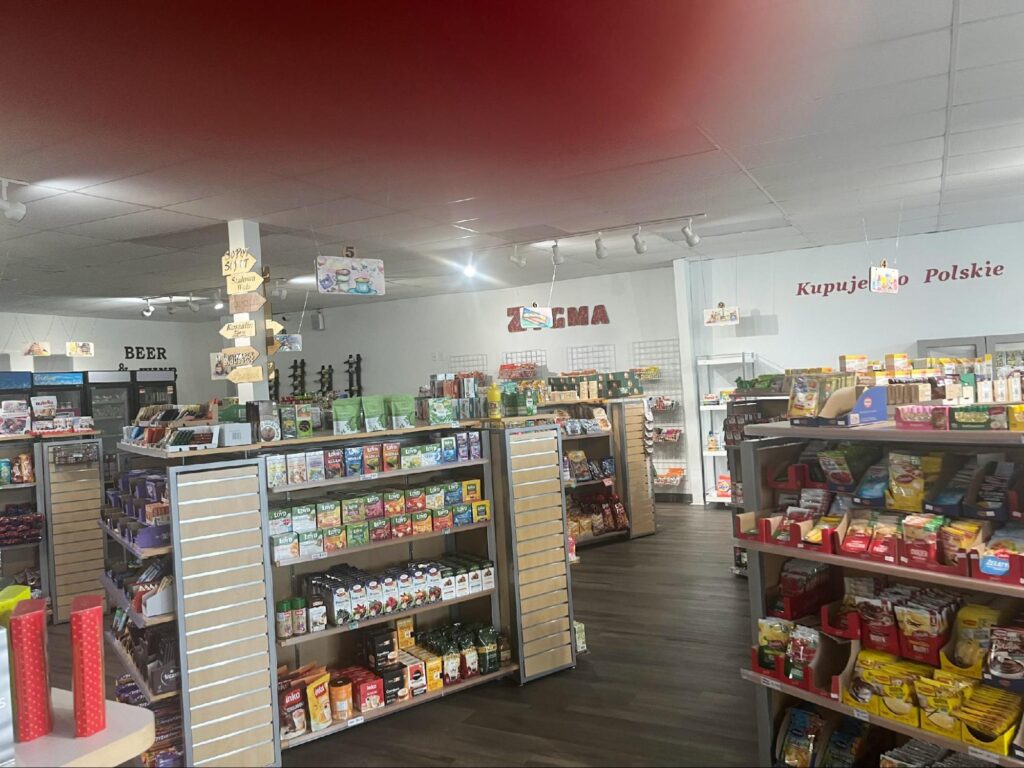
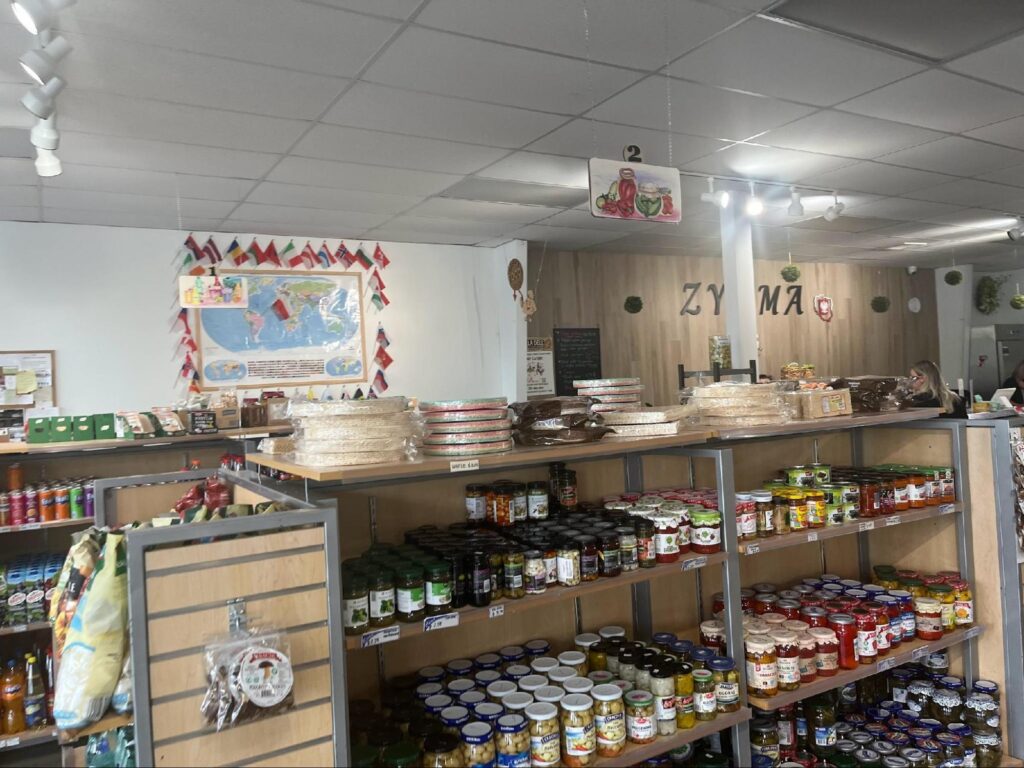
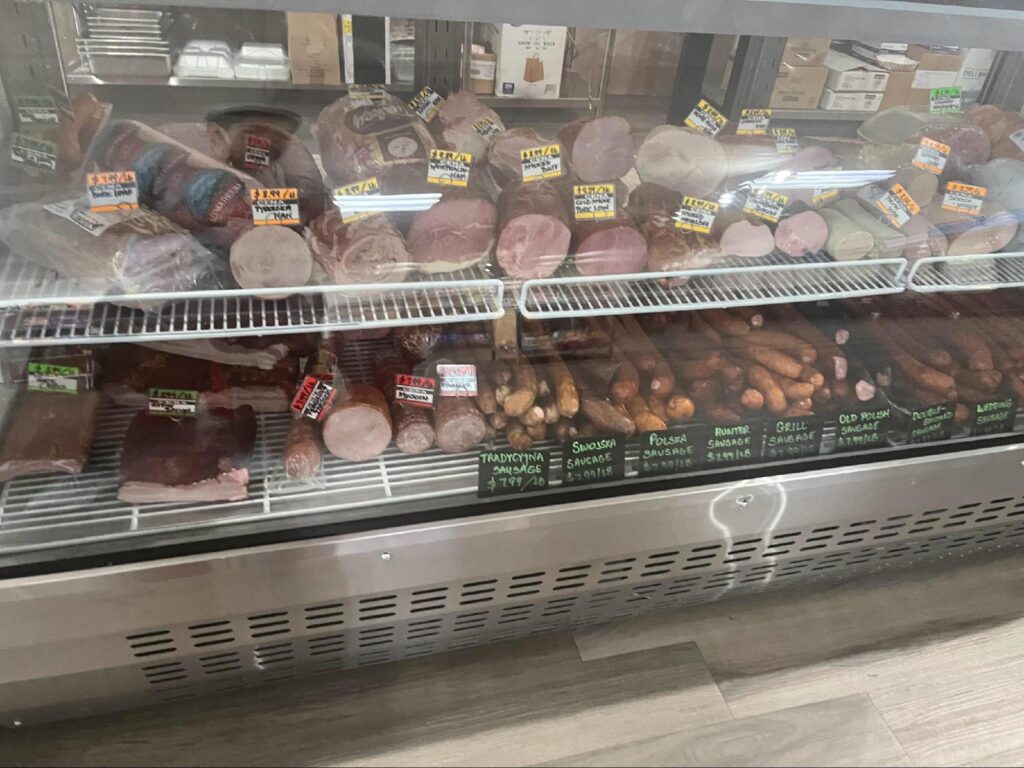
I checked the store out, and there were a number of decently sized sections containing packaged foods. I noticed that there were more pickled and preserved items in Zygma, as compared to Hatoya which had very little pickled and preserved items, which is notable since pickles and fermented foods have played a significant role in traditional Japanese cuisine. There was a small section for frozen food, as well as a counter where they sold sausages and baked goods.

However, the most shocking observation was that there were absolutely no fresh foods in the entire store. I looked around, and there were no fresh food or vegetables being sold in the store at all.
Because of this, I think the hypothesis is false. Because we saw a similar-sized grocery store for an entirely different ethnicity, Japanese grocery stores in America are not unique in its lack of fresh food.
Is Hatoya Mart’s lack of fresh food a result of its small size? Analyzing Super G Mart
Our next hypothesis is that Hatoya Mart’s lack of fresh produce could be a result of its small size. This could make sense based on the store’s fundamental economic realities. It’s simply harder to acquire and store fresh produce that’s high quality in a small store like Hatoya Mart, compared to a large chain supermarket or even the konbini with its corporate supply chain. Gavin Whitelaw says that, in Japan, “packaged foods, like instant coffee, sembei (rice crackers), and bottled water are stamped with a “best-before” date, or shomikigen. Best-before dates are typically much longer—half a year or more in some cases—and the rules governing the handling and sale of expired products are less strict” (Whitelaw, 139). For smaller stores, it’s simply easier to stock and re-stock products that have a longer expiry date, while large supermarkets have a much easier time stocking fresh food.
There is a supermarket a few minutes away from Hatoya called Super G Mart, which appears to be Korean owned. It seems to position itself as an international market, offering foodstuffs from all cuisines, so I went looking to see how many brands are Japanese, as well as how much fresh food for Japanese cuisine they offer.
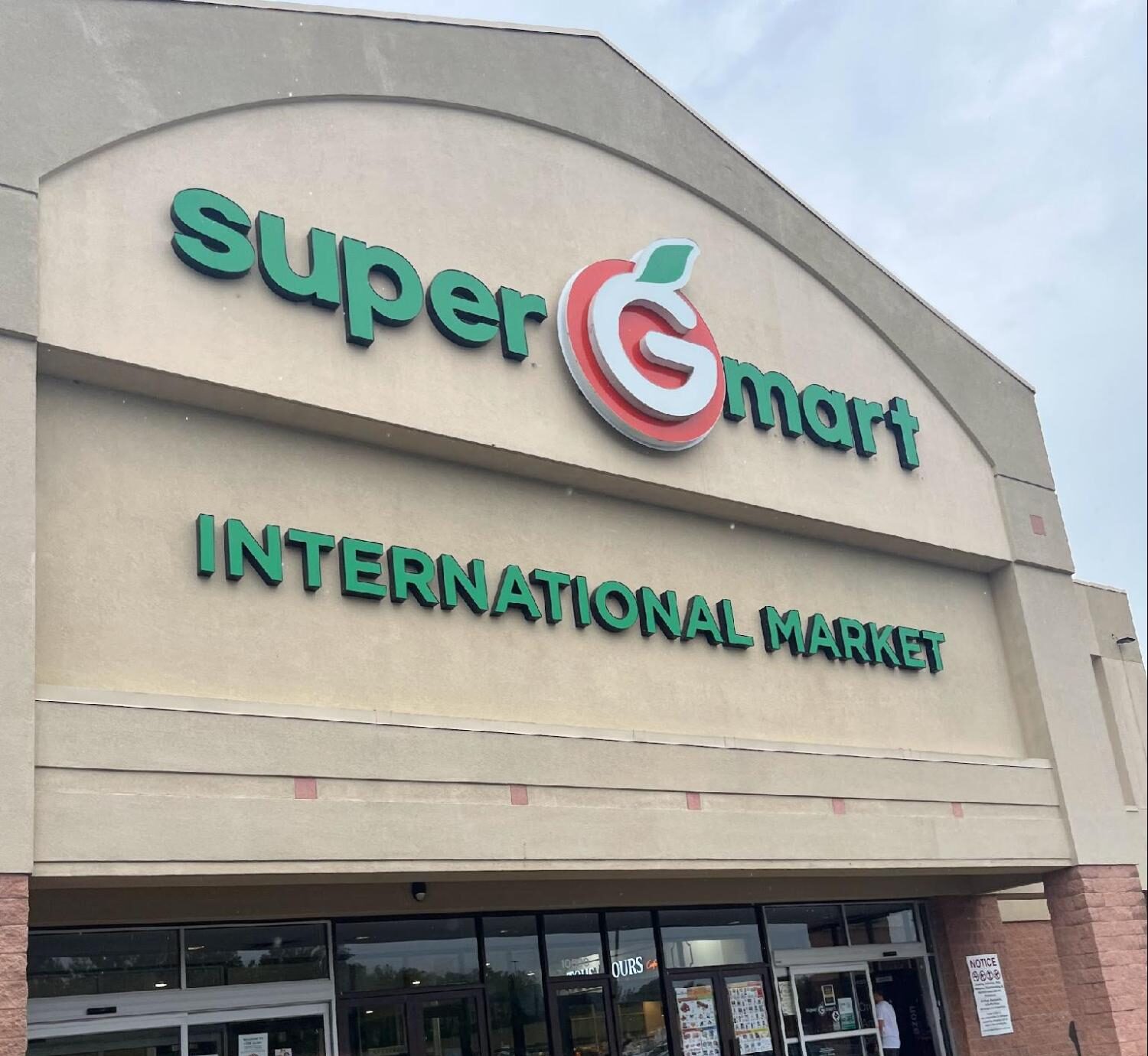
I immediately noticed, right before entering the store, that there was a sign warning against reselling food stamps. This was surprising to me, because I haven’t really seen a sign like this before. It makes me wonder if the town of Pineville was more working-class or lower-income than I had imagined.

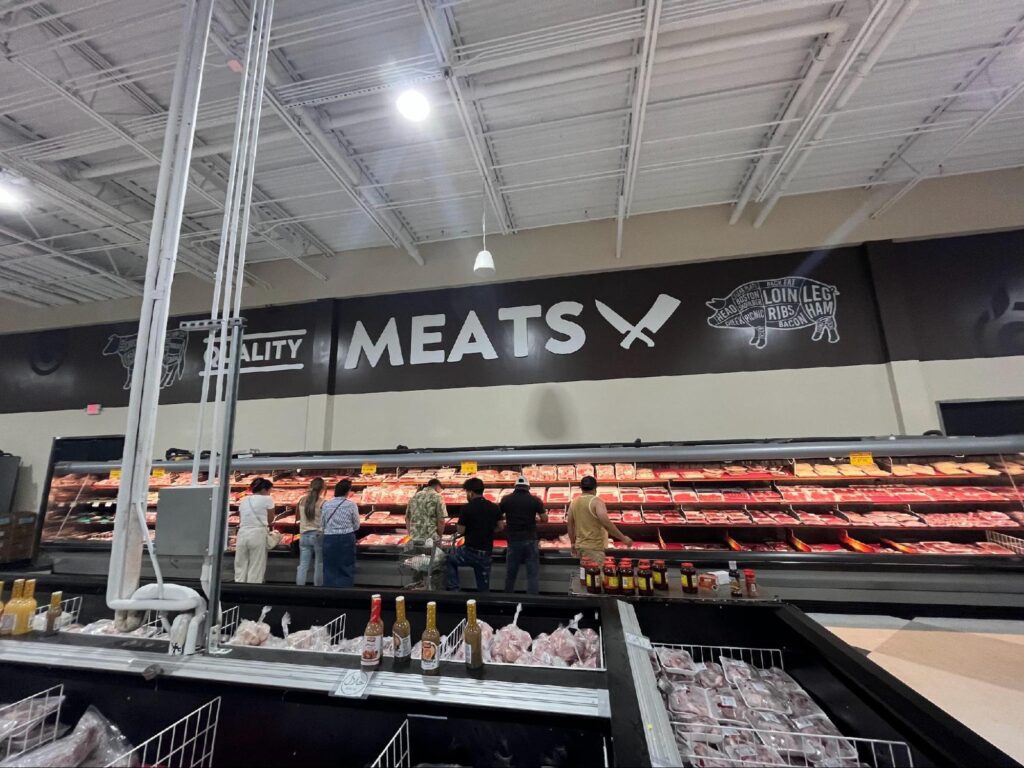
When I entered, the store was much larger than I expected. It was larger than even an American supermarket, and was about 5 times larger than Hatoya Mart. The produce section was gigantic, with around 30% of the store being dedicated to fresh produce. This includes a large array of fruits, vegetables, meats, and most interestingly a miniature fish market inside the store.
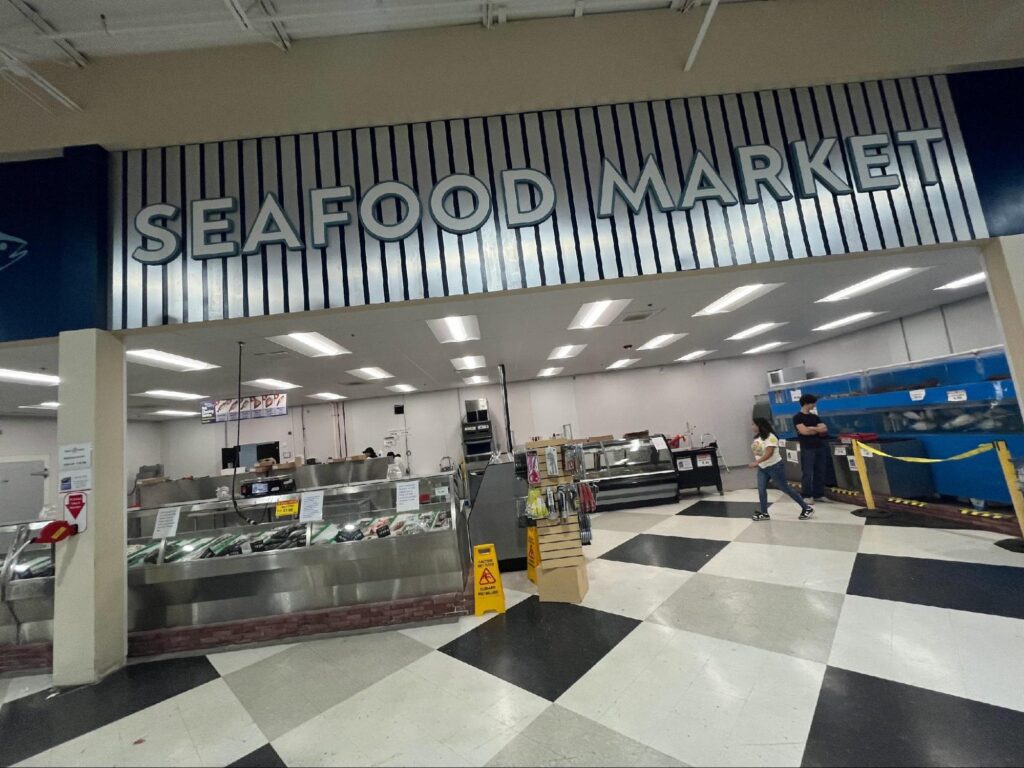
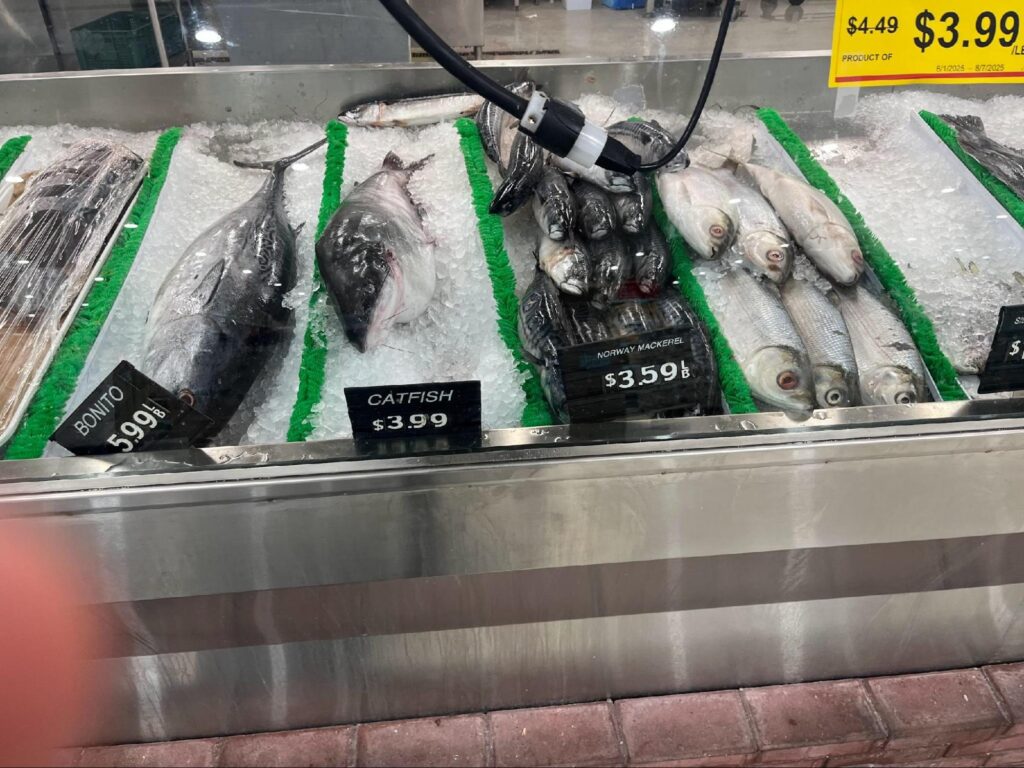
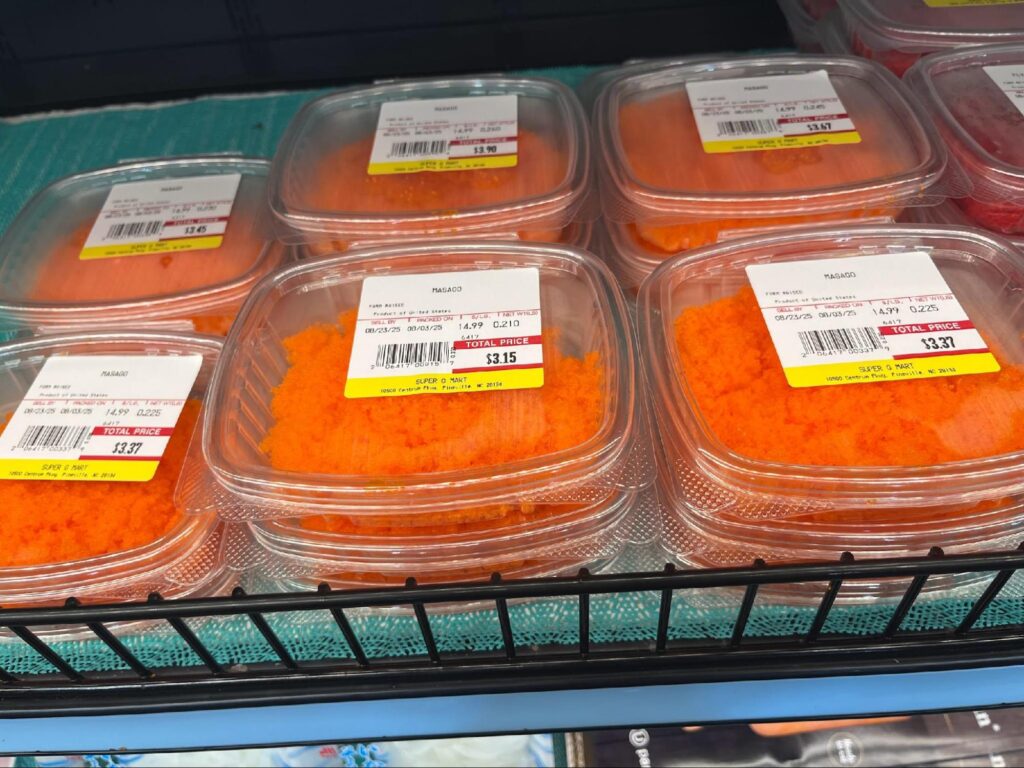
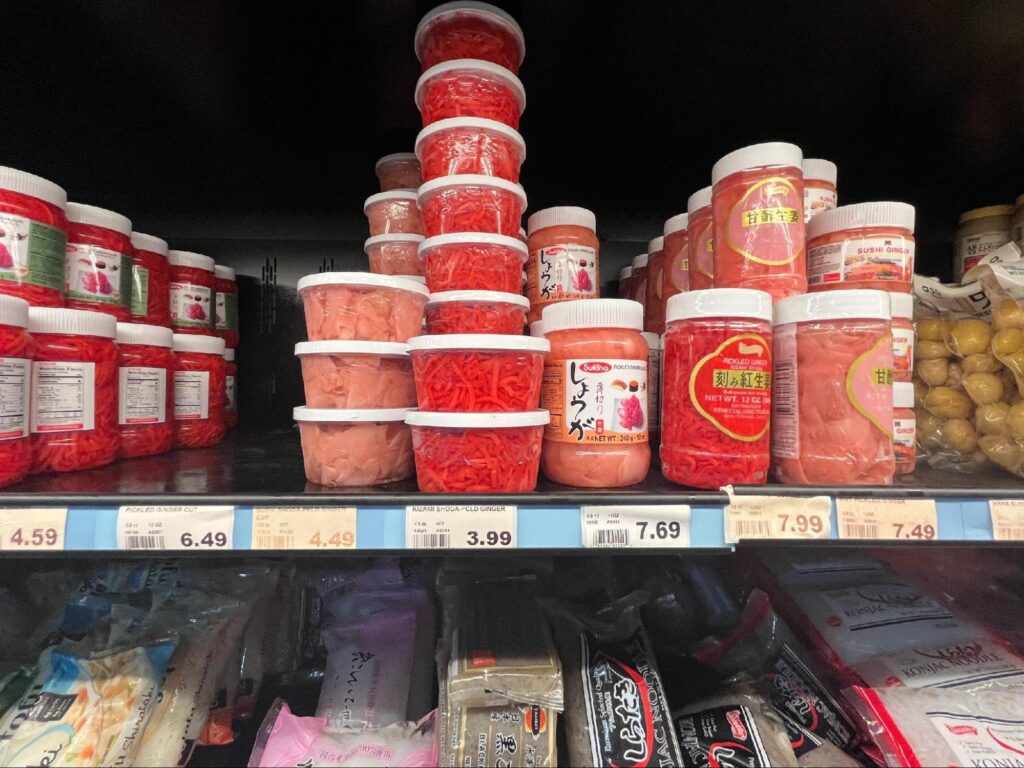
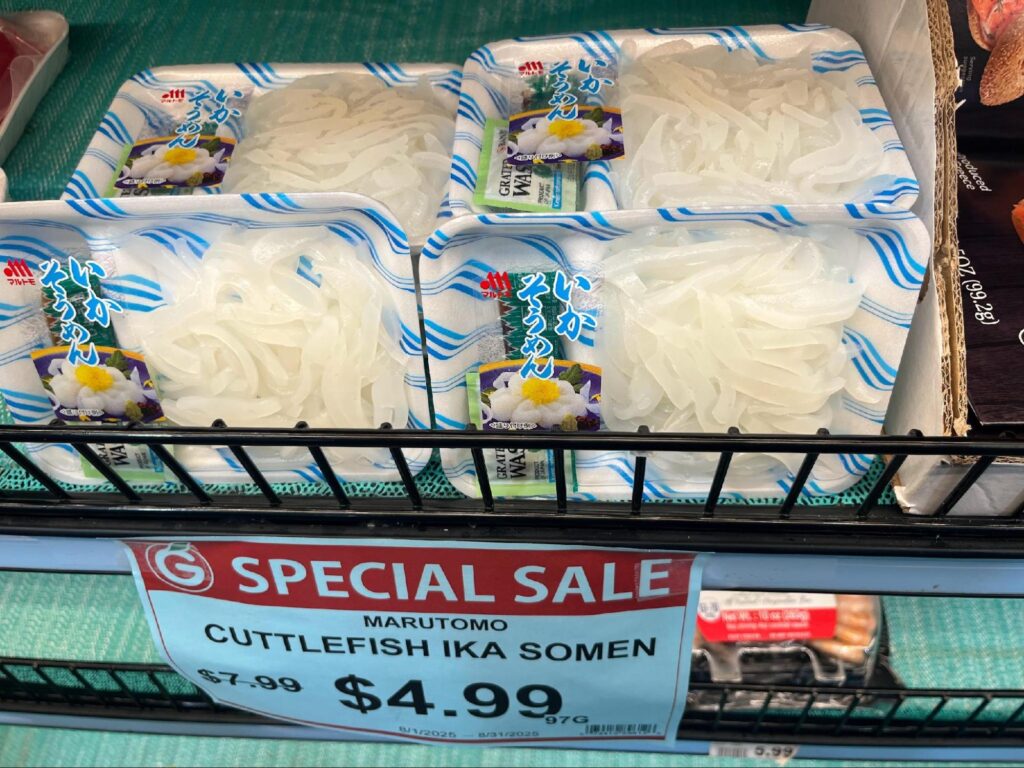
There’s a lot of useful Japanese seafood products in the store that are probably used a lot in Japanese cuisine.

There’s lots of important sauces and oils in Japanese cuisine that are also found here, but they seem to be marked by the Hangul script, so I think they’re Korean. There are a lot of Korean, Chinese, and Japanese products, but Japanese products seem to be proportionally much less.

The amount of Japanese packed foods is pretty small. There are a few brands of Japanese sweet treats such as mochi (in what might be more contemporary, globalized renditions).
There could potentially be an overlap between people who go to Super G Mart and Hatoya Mart, and the former could perhaps replace the latter for many shopping needs. I think it’s possible that Japanese people go to Super G Mart for the Japanese produce, and then Hatoya Mart for the Japanese packaged foods. If you look at the google reviews for both stores, this can be confirmed. Here’s the reviews of Hatoya Mart; you can see clearly that most people seem to go there for the snacks and sake.

Meanwhile, here are the reviews for Super G Mart. You can see that there’s more reviews for produce.

The hypothesis does indeed hold to be true, with an added caveat. Hatoya Mart’s status as a small store makes it more difficult to get good produce, but Hatoya Mart also chooses to specialize in packaged foods while Super G Mart specializes in fresh produce.
Final Analysis and Conclusion
Hatoya Mart, while similar to many other small grocery stores targeting a specific ethnicity, has a unique dynamic with the stores around it. In a way, Hatoya Mart and Super G Mart are able to synergize, with both stores working together to offer a more complete experience for Japanese customers. This form of cooperation isn’t uncommon, as explained by Paul B Elligson and Sanjog Misra. They say: “stores competing in a given market have incentives to coordinate their actions. Rather than choosing a pricing strategy that distinguishes them from their rivals, stores choose strategies that match” (Elligson and Misra, 812). Even though this study deals with the pricing of grocery store products and not the specific type, it can still be used to understand how grocery stores operate. Even though there is a lot of cutthroat competition in this industry, there can still be times where stores can cooperate to the benefit of both businesses. Even though Super G Mart is in the dominant position and could theoretically put Hatoya Mart out of business by increasing their amount of packaged Japanese products, they won’t do so because of the time and money it would take to compete and to make a profit on those items, which might not sell well at G Mart. In the end, I think Hatoya Mart is a good representation of how Japanese cuisine exists in some parts of the US, particularly those that are not known for its Japanese communities, as well as of the unique dynamics of international grocery stores in America.
Works Cited
Ellickson, Paul B., and Sanjog Misra. “Supermarket Pricing Strategies.” Marketing Science, vol. 27, no. 5, 2008, pp. 811–28. JSTOR, http://www.jstor.org/stable/40057128. Accessed 12 Aug. 2025.
Whitelaw, Gavin. “Shelf Lives.” Wesleyan.edu, 2017, wesmoodle.wesleyan.edu/pluginfile.php/1919163/mod_resource/content/0/Whitelaw%20Shelf%20Lives.pdf. Accessed 12 Aug. 2025.
HATOYA MART. “HATOYA MART.” HATOYA MART, 2020, hatoyamart.com/. Accessed 12 Aug. 2025.
Heldke, Lisa. “Let’s Eat Thai.” Wesleyan.edu, 2017, wesmoodle.wesleyan.edu/pluginfile.php/1919111/mod_resource/content/0/Heldke%20Lets%20Eat%20Thai.pdf. Accessed 12 Aug. 2025.
“Pineville, NC | Data USA.” Datausa.io, 2023, datausa.io/profile/geo/pineville-nc#race_and_ethnicity. Accessed 12 Aug. 2025.