Introduction
“I should like, I think, to die of consumption… because then the women would all say, ‘see that poor Byron—how interesting he looks in dying!’”: English poet Lord Byron supposedly made this remark to a friend, reflecting 19th-century Europe’s romanticization of the disease. Those afflicted were likewise thought to be divinely creative, “the body burning so that the creative soul could be released” (Morens). To die young from consumption, now called tuberculosis (TB), was, for many, an idealized dream (Black, pg. 13).
Japanese poet Masaoka Shiki found no such romantic solace in his diagnosis. Many of his poems—most notably haiku—convey his frustration and sorrow over an illness that, in his later years, kept him confined to bed, doing nothing more strenuous than reading, writing, and eating. Largely, Shiki conveys these emotions through veils of ambiguity and irony, save for one entry in A Drop of Ink, one of three poetry and essay collections Shiki wrote on his sickbed:
11 May. Put some poison beside my bed. Would I take it or not?
(Beichman-Yamamoto; Shiki). When I read Shiki’s work, I was enthralled. In playwriting and academics—my two frequent writing-based activities—alike, my arch-nemesis has been the “maximum word count.” Forced brevity, to me, has long seemed the antithesis of creativity.
Shiki’s poems thus convey a seemingly limitless talent—to perfectly articulate and communicate—in tiny sets of 5-7-5—an emotion or find beauty in the most prosaic objects and actions. It is for good reason that Shiki is widely credited with saving Japanese haiku tradition and adapting it to the modern era (Keene, “Diary of Masaoka Shiki”). Yet in reading and analyzing his poems, two questions kept arising for me.
First, did Shiki’s bedriddenness—or, more specifically, his burden to look at the same things every day—force him to find beauty in the otherwise mundane, or was that an innate skill of his? In other words, if someone else were to have a similarly unchanging view, would they too discover new value in their surroundings? Second, did Shiki always appreciate writing haiku? Certainly, he loved and was drawn to the art, going so far as to claim he was “bewitched…by the demon of haiku” (Beichman-Yamamoto). Yet his prolific oeuvre includes, by some estimates, 25,000 haiku poems (Shin). Were some of these poems created less out of the specific urge to write Haiku, and more out of a simple desire for something to do?
As an attempt to answer these questions, I will, in part, place myself in Shiki’s shoes. For a period of six hours, I will emulate certain aspects of Shiki’s life: I will disconnect from technology, lie in bed with a notebook, and write as many haiku as possible. I will attempt to, at least in part, emulate Shiki’s writing style, as well as aspects of his daily routine. The content of the haiku I create during this experiment will reveal whether, for me, a “fixed, supine position” also leads to the valorization of the mundane. Likewise, I’ll be able to document my attitude towards haiku throughout the experiment. In other words, I’ll document whether I enjoy writing haiku in itself; whether I enjoy just having something to do, haiku or otherwise; or whether I am uninterested in haiku and am continuing solely for the sake of the project.
The Rules
The primary element of Shiki’s lifestyle that I am attempting to emulate is his fixed position. Not only was he confined to his bed, but, as the title of one diary, Stray Notes While Lying on My Back, alludes to, Shiki was largely confined to a single position. He suffered from pulmonary and spinal TB (Green, pg. 63), and the immense pain of pus discharging from tubercle bacillus-infected bones between his upper and lower back made him incapable of even sitting or turning in bed (Sekinaga, et al.; The Winter Sun Shines In, pg. 10). Save for bathroom visits if necessary, I plan to imitate this level of immobility.
Mobility aside, the complete list of rules is as follows:
- While Shiki’s world was confined to his bed, he read newspapers and magazines on a daily basis to stay up-to-date on events happening outside (Mewhinney). In A Six-foot Sickbed, he writes that even when he felt incapable of reading, he would “listen to my family members read the newspapers for me” (Shiki). As such, in addition to a journal for haiku, I will have the two most recent copies of The Wesleyan Argus with me.
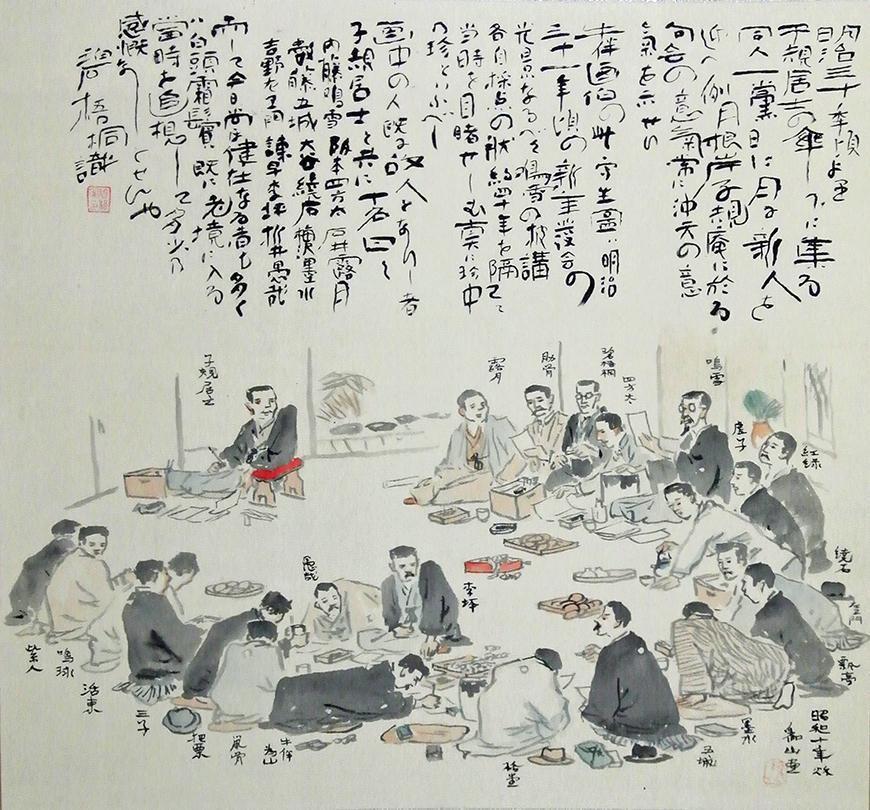 Shiki was blessed with a plethora of disciples who regularly visited his sickroom, often bringing him presents of food, flowers, souvenirs, and gossip (Keene, “Diary of Masaoka Shiki”). Visitations and letters from friends were Shiki’s greatest pleasures, according to Japanese literary scholar Donald Keene (The Winter Sun Shines In, pg. 47). Indeed, they were also Shiki’s single most enduring pleasure; he was able to enjoy the company of others after even his famous appetite had dissipated. For my experiment, I will be visited by friends three times, following an agreed-upon schedule. The middle visit will comprise a larger gathering of friends; we will play a card game, with me participating from the bed, in an altered recreation of the accompanying image. In all three of the meetings, my visitors will be invited, though not required, to bring me small “gifts” and/or letters from other friends.
- As mentioned, and for obvious reasons, I will be disconnected from technology. Every component of the experiment involving other people will be scheduled and coordinated in advance.
- One of Shiki’s most iconic traits was his voracious appetite, particularly for someone suffering from severe TB. Shiki ate about 3,800 calories a day, and may have spent as much money on sashimi each month as he did on rent. Shiki’s appetite literally kept him alive, providing him with both crucial physical and psychological nourishment. Respectively, food gave his body the energy needed to slow the spread of TB, and his frequent and opinionated assessments of food were “a way of constituting and fortifying his sense of self even as his body rotted away” (Vincent, pg. 5). Food was often Shiki’s muse, too. The food in front of him was one of the few variances in his ever-stagnant view, and he benefited psychologically from the uniquely “writerly challenge of describing the taste of food in words” (Vincent, pg. 7). One of my favorite of Shiki’s diary entries exemplifies his “prodigious consumption” (Vincent, pg. 5):
Shit my pants Bandages changed
Lunch: Three bowls of rice gruel with potatoes, bonito sashimi, miso soup with onions and eggplant, tsukudani, two Asian pears, one apple. (Stray Notes While Lying on My Back, pg. 223)
During the second and third visits scheduled for my experiment, my friends will bring me large meals, both to allow me to experience more of Shiki’s lifestyle and to provide me with my own gastronomical muses. (I will cover the cost of the meals, case applicable.)
In addition to emulating aspects of Shiki’s lifestyle, I plan to loosely emulate his writing style. The major components of his writing that I plan to incorporate are as follows:
- Shasei: Shiki adopted the term shasei, meaning “sketch from life,” to describe the underlying methodology of his poetry. As he put it in 1899, “Take your materials from what is around you—if you see a dandelion write about it; if it’s misty, write about the mist. The materials for poetry are all about you in profusion” (Watson, pg. 7; Shiki, Random Questions and Random Answers). Rather than extrapolate beyond what exists, Shiki’s technique involved making minute observations of the scenes around him. Then, he would create works that “[conjure] up the mood or emotional tenor through apt manipulation of the images found in real life” (Watson, pgs. 6-7). Shasei typically equates to empirical and realist representation, though for Shiki, the style was more organic. His prose remained personal, subjective, and ironic, and he played into the poetic “organic form,” in which the prose unfolds naturally, following the poet’s train of thought (Mewhinney). Essentially, Shiki’s underlying style attempted to relay the emotional feel of an actual scene while maintaining the author’s distinct voice. This is the main characteristic of Shiki’s writing that I’ll be employing.
- Sense of Place: Shiki rarely describes a location or an item from a removed, omniscient perspective. Instead, he immerses himself in the environment which he’s writing about, “and frequently makes of himself another bit player in the events” (Hawes, pg. 48).
- Straightforwardness: Shiki largely rejected the use of puns, wordplay, poems that “tell a little story,” and—unlike classical authors like Murasaki Shikibu and Sei Shōnagon—allusions to older literature (Watson, pg. 7). Maintaining this rigidity for me will be difficult—it may contradict all of my writerly impulses—but I’ll attempt to practice this, at least in part.
Haiku
Some of these poems have been edited from their original form for spelling and intelligibility.
|
1
Starting the project Might be three minutes in now The door slowly opens |
2
Covered microwave Now I do not know what the Incorrect time is |
|
3
Empty Nalgene bottle A few drops in it last week I should close the cap |
4
A torn piece of paper A speech bubble? A snow boot? Or Connecticut? |
|
5
I see the leaves shake While lying upon my bed, But can’t feel the wind |
6
“Many Wes students Self-censor their politics”? How’s that inclusive? |
|
7
FIRE did that survey They guard free speech, but not in A movie theater |
8
Plastic bag of yarn I wish I had some needles That said I don’t knit |
|
9
Sketch of Alpine lake I was there just last summer Mountains smudged then, too |
10
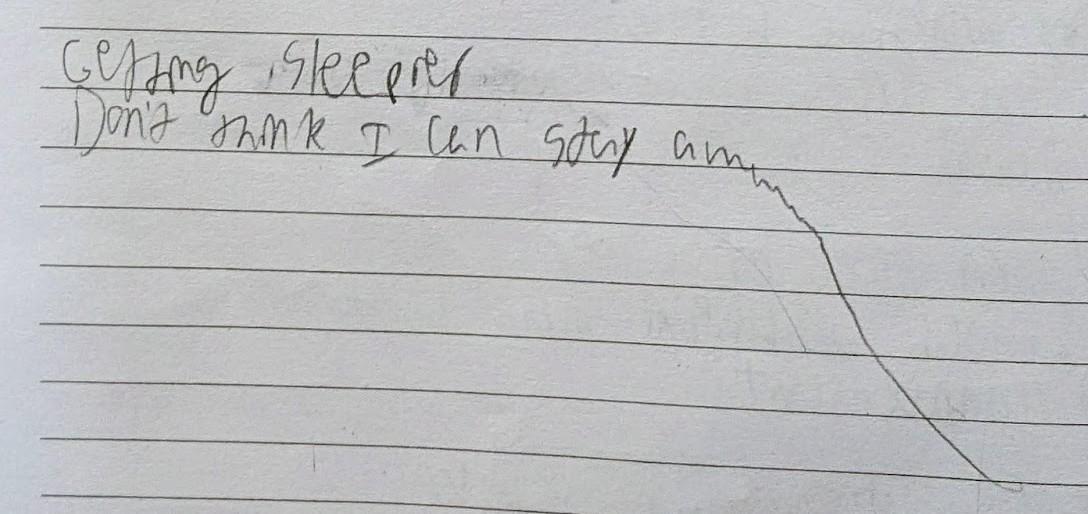
|
|
11
Thompsonville, Waban, Highlands, Center, Corner, West, Ville, Auburndale too |
12
A squishy fidget With makeshift tobiko pearls I’d go for sushi |
|
13
Alyssa comments On the radiant sunset That shines onto her |
14
Plastic fro-yo spoon Bubblegum pink, finger-sized Those poor sea turtles |
|
15
The chicken and rice A Summerfields specialty I shed my blanket |
16
Lying on my bed Playing card games with chicken And rice: My Midterm! |
|
17
I don’t feel left out From the game; I’m left out Cause I can’t stand up |
18
Hues of greens and reds: The leaves beyond my window Apple on my desk |
|
19
I quite have to pee. Shiki just changed his clothes— I’m not doing that |
20
On my wall, all that I have proudly accomplished: Friends, fam, a pennant |
|
21
Caught up on the news, Ampersand pieces were great, I’ll write one next week |
22
Lent the pillow that Looks like my dog. It’s on the Floor now. Stay, boy! |
|
23
Uneventful green An eventful umami Pistach’o ice cream |
24
Matt brought me sushi Wow, that was very yummy I can taste the sea |
|
25
Half an hour to go. I eat a little ginger Cleansed, ready to go |
26
Twice the Nigiri Would still be far too little Best sushi since home |
|
27
Inflating like a Carnival balloon. Oh boy. Too much wasabi! |
28
Rice fell on my shirt I contentedly chewed on What a great project |
|
29
Home stretch, had a ball Some baseball references For Mr. Shiki |
Reflection
Some of my haiku are more or less nonsense, such as #24 and #11. That said, some of my haiku I’m rather proud of, and a few, I think, are decent homages to Shiki’s writing style and tone. #13, for instance, evokes Shiki’s underlying view of his bedriddenness—“as being of the world but also not entirely with the world” (Green, pg. 65). In that poem, I couldn’t see the sunset that my friend was commenting on, but rather its mere reflection onto things in my view.
#22, meanwhile, is an ode to Shiki’s ironic humor, while #26 and #28 convey being lost in the reverie of good food, a quintessential theme of Shiki’s poems.
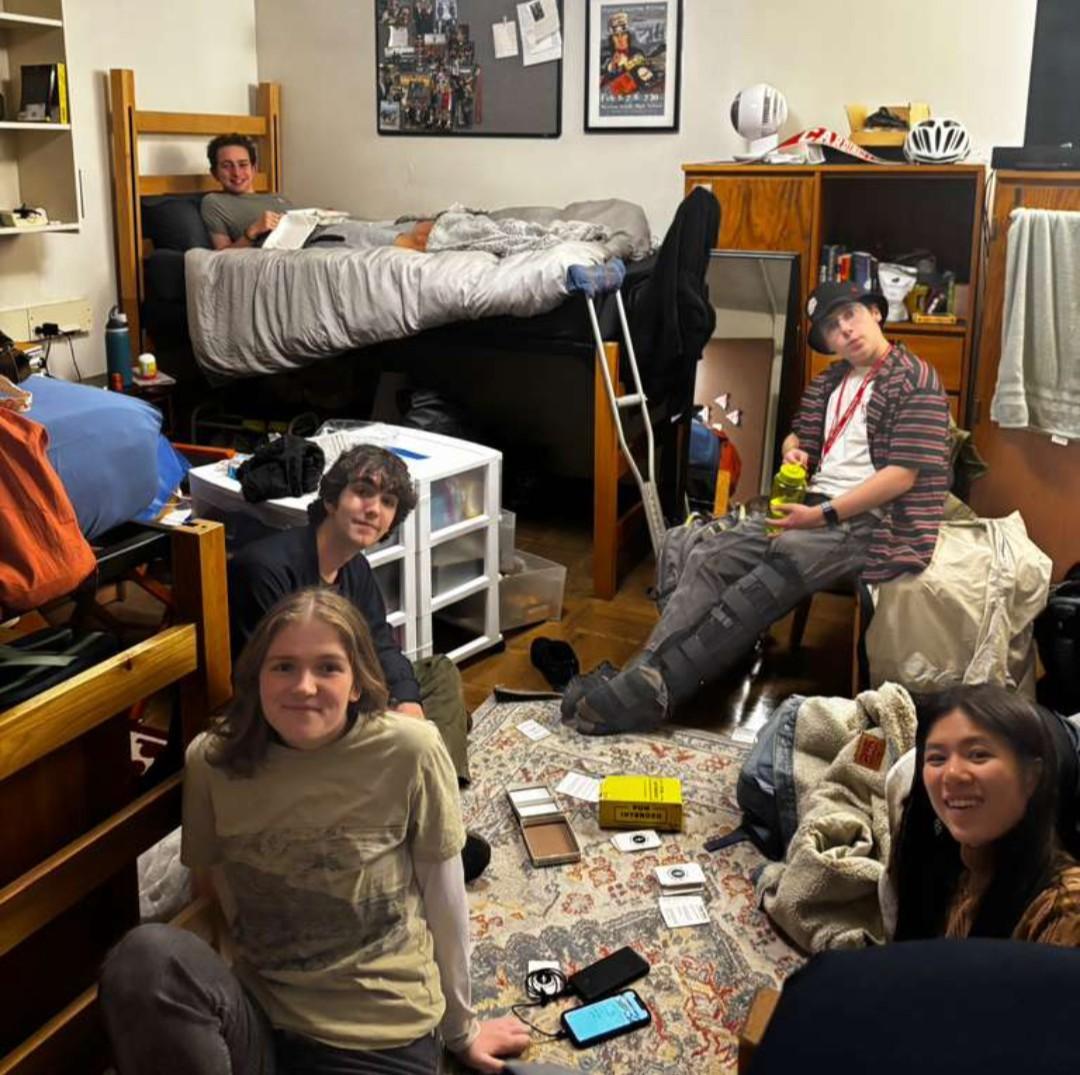
For details, I conducted the experiment on Thursday, October 16th, from 3:36 to 9:36 PM. Aside from one brief bathroom visit, I lay stationary on my back for the entire experiment. This was made possible by the people who visited me, bringing me food and “gifts” for me to write about and suppressing some of the tediousness of the experiment. Ten different people visited throughout, and some visited more than once. As seen in the attached image, I was able to loosely recreate the scene that Shiki is depicted in above. This experience within the experiment was particularly memorable, as it best created for me a feeling of “other-ness,” or of being distinctly separate from everyone else.
There were, in fairness, flaws inherent in the experiment. Obviously, my experiences aren’t scientifically conclusive answers to the questions. Rather, they allowed me to understand Shiki and his poetry at a slightly deeper level than I believe I could have otherwise. Further, the three most crucial elements of Shiki’s existence were lacking: the experiment was relatively short, I don’t actually have tuberculosis, and I knew exactly when the experiment would end. Shiki’s ordeal lasted years. He couldn’t just get up to use the bathroom if he wanted to, nor could he decide to end the “experiment” at any time. Given his state, he knew that the “experiment” would only expire when he did. As such, it would have been ludicrous for me to attempt to emulate his emotional or psychological states in any way. Glaringly, this limits the extent to which this experiment could be successful. Yet, granted the inherent and unavoidable flaws of this experiment, I still found significant value in the lifestyle elements I did emulate.
As to my guiding questions, while I’m not sure it comes across in my haiku, being confined to a stagnant view certainly gave me a greater appreciation for my surroundings. I don’t think I ever quite romanticized my surroundings, per se, but I certainly found more value in things like a scrap of paper or a plastic spoon than I would’ve otherwise. It is also likely that I would have progressively found more and more value in my surroundings as they became the norm, should the experiment have gone on longer. As such, my conclusion is that anyone confined to a fixed viewpoint would eventually find beauty in the prosaic, but that Shiki’s particular skill set made him especially adept at articulating this recognition. For my second question, I was surprised to find that I enjoyed writing haiku throughout. It was nice to have an outlet for creative energy when I was incapable of expending much physical energy, and the conciseness of a haiku was an enjoyable challenge. However, I’m positive that the task would have gotten old fairly quickly had the experiment gone on. I’d suspect that Shiki’s excessive love for haiku made him more partial to it as a recreational activity for a long period of time, as opposed to others like myself who would’ve likely tired of it quicker. Nevertheless, I have to imagine that even Shiki felt the task tedious at times, and that he continued partly out of the need for the income as well as out of certain obstinate momentum of his sheer will (as in maintaining his poetic identity and “streak”). I’m sure he also felt gratitude, too, for having some distraction from the boredom and the pain he had to face every day.
Finally, I thoroughly enjoyed this project. It was, in all respects, a unique experience, and I think its immersive nature amplified my respect for and understanding of Shiki’s prowess more than simply emulating his poetic style could have.